Section #3 - Foreign threats to national security end with The War Of 1812
Chapter 27: Jefferson’s Second Term
1804
The Presidential Election Of 1804
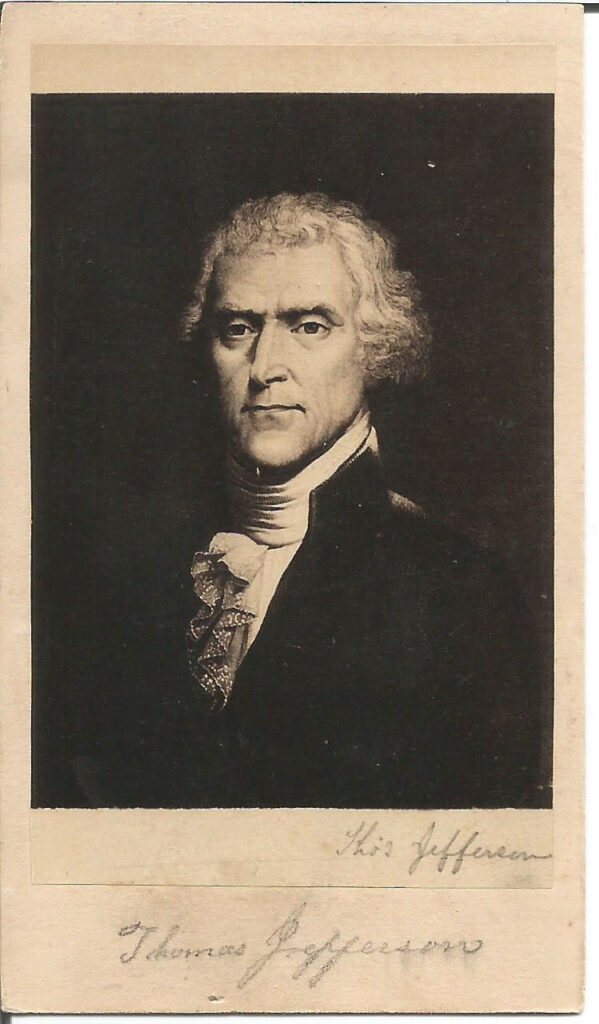
As the 1804 election approaches, Jefferson and the Democratic Republicans discard Aaron Burr as their Vice-Presidential candidate in favor of former General George Clinton, now sitting Governor of New York.
With Washington and Hamilton dead and Adams out of the picture, the Federalists begin what will be an on-going struggle to find a candidate capable of winning widespread popular support. In 1804 they choose Charles C. Pinckney, an aristocratic planter from Charleston, Revolutionary War General, influential pro-slavery delegate to the 1787 Constitutional Convention, Minister to France under Washington, and running mate of Adams in 1800.
In advance of the election of 1804, the states have ratified the 12th Amendment to the Constitution in order to distinguish between party candidates running for President vs. Vice President. This is accomplished by a simple change – having the electoral college shift from one combined vote for the offices, to two separate votes, one for President, the other for Vice President. Any “ties” will still be broken in Congress, the House voting on President, the Senate on Vice-President. The possibility of having a President from one party and a Vice-President from the other remains.
Change To Voting Procedures Beginning With 1804 Presidential Election
| Prior voting process | One ballot, with top vote getter becoming President and the runner-up as VP |
| After 12th Amendment | Two ballots, one for President and the other for Vice-President |
The election takes place between November 2 and December 5, 1804.
A total of 143,110 “popular votes” are cast, double the level recorded in 1800. Eligibility continues to be limited to white men owning various threshold levels of property – and only 11 of the 17 states factor popular votes into their process for choosing “presidential electors. (In the other six they are chosen exclusively by state legislators.)
Still, the 1804 election is the first where mainstream Americans begin to feel that their direct votes have a great deal to do with who will be President. This trend will grow over time, much to the chagrin of the 1787 convention delegates who felt that selection of the Executive was much too important to be left up to “popular passions.”
Growth In Popular Voting For Presidential Electors
| 1788 | 1792 | 1796 | 1800 | 1804 | |
| Popular Votes | 43,782 | 28,579 | 66,841 | 67,282 | 143,110 |
| # States w popular votes for electors | 7 of 12 | 6 of 15 | 9 of 16 | 6 of 16 | 11 of 17 |
When the ballots are all in, Jefferson is re-elected by an overwhelming majority. He beats Charles C. Pinckney by a 73% to 27% margin in the popular vote, and by 162-14 in the electoral college. He carries 15 of the 17 states (losing only in Connecticut and Delaware), including prior Federalist strongholds across the North.
Results Of The 1804 Presidential Election
| Candidates | State | Party | Pop Vote | Tot EV | South | Border | North | West |
| Thomas Jefferson | Va. | Dem Republican | 104,110 | 162 | 59 | 17 | 83 | 3 |
| Charles C. Pinckney | S.C. | Federalist | 38,919 | 14 | 0 | 5 | 9 | 0 |
| Total | 143,110 | 176 | 59 | 22 | 92 | 3 | ||
| Needed to win | 89 |
Note: Total # electors = 176,; must get more than half of 138 voters = 70.
The same story holds true in the race for Vice-President, where Governor Clinton easily outdistances Rufus King, the New York Federalist and former Ambassador to Britain under Washington.
1804 Electoral College Vote For VP
| Candidate | Party | Votes |
| George Clinton | Dem-Rep | 162 |
| Rufus King | Federalist | 14 |
| Total | 176 |
Jefferson’s victory reflects approval for his Louisiana Purchase and an uptick in the economy in 1803-4, after a lessening of tensions with France.
1804
The Democratic-Republicans also dominate the Federalists in the 1804 Congressional races.
In the House, the total number of seats up for grabs has expanded from 106 to 142 based on the new population counts from the 1800 Census. The largest gains in apportionment are in the Northern states, a fact that is already troubling to politicians in the South.
Apportionment Of House Seat After The 1800 Census
| Total | South | Border | North | West | |
| 1790 | 65 | 23 | 7 | 35 | 0 |
| 1800 | 106 | 38 | 11 | 57 | 0 |
| 1802 | 142 | 49 | 16 | 76 | 1 |
| Change vs. 1790 | +77 | +26 | +9 | +41 | +1 |
The margin of victory for the Democratic-Republicans in the lower chamber is remarkable. Only six years earlier, in 1799, the Federalists held the House by 14 seats (60-46). After the 1804 votes are in, they trail their opponents by 86 seats (28-114).
Election Trends – House Of Representatives
| Party | 1789 | 1791 | 1793 | 1795 | 1797 | 1799 | 1801 | 1803 | 1805 |
| Democratic-Republicans | 28 | 30 | 55 | 61 | 49 | 46 | 68 | 102 | 114 |
| Federalist | 37 | 39 | 50 | 45 | 57 | 60 | 38 | 40 | 28 |
| Congress # | 1st | 2nd | 3rd | 4th | 5th | 6th | 7th | 8th | 9th |
| President | GW | GW | GW | GW | JA | JA | TJ | TJ | TJ |
In addition to continuing their dominance across the South, the Democratic-Republicans have now won solid majorities in the North in both 1802 and 1804.
House Trends By Region
| Democratic-Republican | Total | South | Border | North | West |
| 1789 | 28 | 16 | 4 | 8 | |
| 1791 | 30 | 16 | 5 | 9 | |
| 1793 | 55 | 31 | 7 | 17 | |
| 1795 | 61 | 33 | 7 | 21 | |
| 1797 | 49 | 30 | 4 | 15 | |
| 1799 | 46 | 21 | 5 | 20 | |
| 1801 | 68 | 30 | 7 | 31 | |
| 1803 | 102 | 42 | 13 | 46 | 1 |
| 1805 | 114 | 48 | 13 | 52 | 1 |
| Change Vs. ‘03 | +12 | +6 | NC | +6 | NC |
| Federalists | |||||
| 1789 | 37 | 7 | 3 | 27 | |
| 1791 | 39 | 7 | 4 | 28 | |
| 1793 | 50 | 6 | 4 | 40 | |
| 1795 | 45 | 5 | 4 | 36 | |
| 1797 | 57 | 8 | 7 | 42 | |
| 1799 | 60 | 17 | 6 | 37 | |
| 1801 | 38 | 8 | 4 | 26 | |
| 1803 | 40 | 7 | 3 | 30 | |
| 1805 | 28 | 1 | 3 | 24 | |
| Change Vs. ‘03 | (12) | (6) | NC | (6) | NC |
In the Senate, the Democratic-Republicans now enjoy a 27-7 margin over the Federalists, after a pick-up of two more seats. Recent additions in the upper chamber include the Federalist John Quincy Adams of Massachusetts in 1802 and Henry Clay of Kentucky in 1804, who begins his career as a Democratic-Republican.
Election Trends — Senate
| Party | 1789 | 1791 | 1793 | 1795 | 1797 | 1799 | 1801 | 1803 | 1805 |
| Democratic-Republicans | 7 | 12 | 14 | 16 | 12 | 10 | 17 | 25 | 27 |
| Federalists | 19 | 17 | 16 | 14 | 20 | 22 | 15 | 9 | 7 |
| Congress # | 1st | 2nd | 3rd | 4th | 5th | 6th | 7th | 8th | 9th |
| President | GW | GW | GW | GW | JA | JA | TJ | TJ | TJ |
Regional results in the Senate mirror those in the House, with a steady erosion for the Federalists in the North.
Senate Trends By Region
| Democratic-Republican | Total | South | Border | North | West |
| 1789 | 7 | 4 | 1 | 2 | |
| 1791 | 12 | 5 | 2 | 5 | |
| 1793 | 14 | 7 | 2 | 5 | |
| 1795 | 16 | 7 | 4 | 5 | |
| 1797 | 12 | 8 | 1 | 3 | |
| 1799 | 10 | 8 | 1 | 1 | |
| 1801 | 17 | 10 | 3 | 4 | |
| 1803 | 25 | 10 | 4 | 9 | 2 |
| 1805 | 27 | 10 | 4 | 11 | 2 |
| Change Vs. ‘03 | 2 | NC | NC | 2 | NC |
| Federalists | |||||
| 1789 | 19 | 4 | 3 | 12 | |
| 1791 | 17 | 3 | 4 | 10 | |
| 1793 | 16 | 1 | 4 | 11 | |
| 1795 | 14 | 1 | 2 | 11 | |
| 1797 | 20 | 2 | 5 | 13 | |
| 1799 | 22 | 2 | 5 | 15 | |
| 1801 | 15 | 0 | 3 | 12 | |
| 1803 | 9 | 0 | 2 | 7 | |
| 1805 | 7 | 0 | 2 | 5 | |
| Change Vs. ‘03 | (2) | NC | NC | NC |
Overall then, the Democratic-Republicans emerge from the 1804 election in firm control of the Presidency and both chambers of Congress – while the Federalists are left reeling.
March 4, 1805
Jefferson’s Second Inaugural Address
On March 4, 1805, Jefferson delivers his second inaugural address in the Senate chamber. Unlike the soaring rhetoric achieved four years ago, his tone is defensive, aimed at justifying his policies and programs against what he regards as ongoing slanders by the press – especially surrounding his mistress, Sally Hemmings.
He seeks peace with the major foreign powers…
In the transaction of your foreign affairs, we have endeavored to cultivate the friendship of all nations, and especially of those with which we have the most important relations.
Restraint on taxes and federal spending, to help fund targeted infrastructure improvements…
The suppression of unnecessary offices, of useless establishments and expenses, enabled us to discontinue our internal taxes. The remaining revenue on the consumption of foreign articles, is paid cheerfully by those who can afford to add foreign luxuries to domestic comforts…it may be the pleasure and pride of an American to ask, what farmer, what mechanic, what laborer, ever sees a tax-gatherer of the United States?
These contributions enable us to give support… in time of peace, to rivers, canals, roads, arts, manufactures, education and other great objects within each state. In time of war… by other resources reserved for that crisis… War will then be but a suspension of useful works, and a return to a state of peace, a return to the progress of improvement.
Support for his controversial Louisiana Purchase…
I know that the acquisition of Louisiana has been disapproved by some, from a candid apprehension that the enlargement of our territory would endanger its union…. and in any view, is it not better that the opposite bank of the Mississippi should be settled by our own brethren and children, than by strangers of another family?
Favorable treatment of the native American tribes…
Humanity enjoins us to teach (our aboriginal inhabitants) agriculture and the domestic arts; to encourage to that industry which alone can enable them to maintain their place in existence…. But the endeavors to enlighten them… have powerful obstacles to encounter.
An end of the personal attacks he has suffered in the press…
During this course of administration, and in order to disturb it, the artillery of the press has been levelled against us, charged with whatsoever its licentiousness could devise or dare. These abuses of an institution so important to freedom and science, are deeply to be regretted.
Our fellow citizens have looked on, cool and collected… they gathered around their public functionaries, and when the constitution called them to the decision by suffrage, they pronounced their verdict, honorable to those who had served them, and consolatory to the friend of man, who believes he may be intrusted with his own affairs…our wish, as well as theirs, is, that the public efforts may be directed honestly to the public good.
And guidance from that “Being in whose hands we are.”
I shall now enter on the duties to which my fellow citizens have again called me, and shall proceed in the spirit of those principles which they have approved. I fear not that any motives of interest may lead me astray; I shall need, too, the favor of that Being in whose hands we are secure to you the peace, friendship, and approbation of all nations.
March 4, 1805 – March 4, 1809
Overview Of Jefferson’s Second Term
Jefferson’s wish to concentrate on domestic policy in his second term will be frustrated by America’s inevitable entanglement in the warfare between Napoleon’s France and Great Britain.
As the term begins, the President’s cabinet is largely unchanged from before, except for Clinton as Vice-President and the Virginian, John Breckinridge, as Attorney General.
Thomas Jefferson’s Cabinet In 1805
| Position | Name | Home State |
| Vice-President | George Clinton | New York |
| Secretary of State | James Madison | Virginia |
| Secretary of Treasury | Albert Gallatin | Pennsylvania |
| Secretary of War | Henry Dearborn | Massachusetts |
| Secretary of the Navy | Robert Smith | Maryland |
| Attorney General | John Breckinridge | Virginia |
James Monroe continues as Ambassador to France, with ex-New York Senator John Armstrong remaining in London at the Court of St. James.
Jefferson’s financial priority lies in ridding the nation of debt, by reducing the size of the standing army and trimming other federal expenses.
I place economy among the first and most important virtues and public debt as the greatest of dangers to be feared. To preserve our independence, we must not let our rulers load us with public debt.
His commitment to an agrarian economy and way of life is undiminished.
Those who labour in the earth are the chosen people of God, if ever he had a chosen people, whose breasts he has made his peculiar deposit for substantial and genuine virtue. It is the focus in which he keeps alive that sacred fire, which otherwise might escape from the face of the earth.
Achieving this idyllic vision rests on geographic expansion – opening more available land for farming.
With the Louisiana Territory already in hand, he now tries, unsuccessfully, to buy Florida and Cuba from Spain.
He also has William Henry Harrison, Territorial Governor of Indiana, negotiate two sizable land cessions with native tribes to the west. Unlike his successors, Jefferson claims to be favorably impressed by the capacities of the Indians, and hopes to teach them agricultural skills and assimilate, rather than banish, them. His actions, however, will often belie his words in this regard.
1804 Cessions Of Tribal Lands To The West
| Treaty of: | Main Tribes | Land Ceded to U.S. |
| Vincennes | Miami and Shawnee | 1.6 million acres in central Indiana |
| St. Louis | Fox and Sauk | 5.0 million acres in Wisconsin |
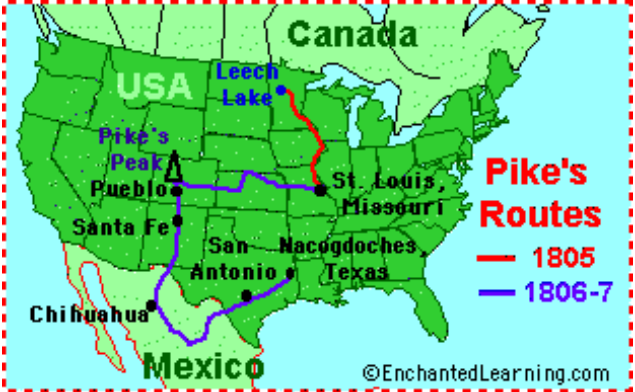
His far westward explorations continue, with news flowing in from Lewis and Clark about the Missouri River and a pathway to the west coast, and with another expedition setting out under Zebulon Pike.
Pike – later an army General killed in the War of 1812 – heads into the Louisiana Territory, first up north to Minnesota, then across the southwest to find the headwaters of the Red River and the Arkansas River. This takes him into Arizona, New Mexico, and Colorado, and the famous Rocky Mountain peak that bears his name.
As he drives westward, Jefferson is intent on weaving the new lands into the fabric of the Union.
To link the old east with the new west commercially, he initiates and funds two major road building projects — despite his philosophical aversion to federal spending and debt.
Jefferson’s Major Road Initiatives
| Name | Approved | Miles | Linking |
| Cumberland Road | 1806 | 620 | Cumberland, Md to Vandalia, IL |
| Natchez Road | 1806 | 500 miles | Nashville, Tn to Natchez, Miss. |
While Jefferson is pleased with this progress on the domestic front, he soon finds that threats to national security are occupying more and more of his time and energy.
One threat is particularly grating. Just as he is trying to glue new states onto the Union, he learns that his former Vice-President, Aaron Burr, is plotting with James Wilkinson, his Territorial Governor in Louisiana, to mount a “filibustering” campaign – to create an independent confederation of states extending through New Orleans and into Mexico. He will go after Burr with a vengeance for this transgression.
But the Burr affair is nothing compared to the repeated acts of war being committed against the United States by Britain and France on the high seas throughout Jefferson’s second term – as Napoleon attempts to achieve worldwide hegemony between 1805 and 1815.
The US role in the grand scheme is largely that of a pawn — with the two super-powers intent on blocking all shipping traffic between America and ports controlled by the enemy. To do so means breaking commercial laws — interfering with US ships at sea, turning them back or attacking them outright, seizing their cargoes and impressing their sailors into foreign duty.
After negotiating efforts in Paris and London fail, Jefferson makes a fatal error in attempting to stay out of the war.
To demonstrate neutrality toward both sides, he secures passage of the 1807 Embargo Act, which bans US ships from sailing to all foreign ports. But this move not only fails to improve diplomatic relations, it also crushes the east coast shipping industry. In 1808 the value of U.S. exports fall by almost 80% and talk of “nullification” forces the President to repeal the Act just prior to leaving office.
Value Of U.S. Exports: Before – After Embargo Act
| 1805 | 1806 | 1807 | 1808 | |
| $ 000 | 95,566 | 101,537 | 108,343 | 22,431 |
| % Ch | 6% | 7% | (79%) |
Across his entire time in office, the overall economy drifts up and down, with per capita GDP ending in 1808 about where it was in 1801.
Economic Growth During Jefferson’s Two Terms
| 1801 | 1802 | 1803 | 1804 | 1805 | 1806 | 1807 | 1808 | |
| Total GDP ($MM) | 514 | 451 | 487 | 533 | 561 | 617 | 589 | 646 |
| Per Capita GDP | 94 | 80 | 84 | 89 | 91 | 97 | 89 | 95 |
| % Change | (15%) | 5% | 6% | 2% | 6% | (8%) | 7% |
Milestones during Jefferson’s second term are as follows:
Jefferson’s Second Term: Key Events
| 1805 | |
| March 4 | Jefferson and Clinton are inaugurated |
| April 29 | Marines take the port of Derna, a turning point in the Tripolitan War |
| May 25 | A labor strike by the Cordwainer’s Union in Philadelphia is suppressed |
| June 4 | War with Tripoli ends with peace treaty |
| July 23 | Britain invokes Rule of 1756 further constraining US shipping to France |
| August 9 | Zebulon Pike begins first expedition, north into the Louisiana Territory |
| October 18 | Lewis and Clark sight Mt. Hood |
| October 21 | Nelson defeats the French fleet at Trafalgar foiling invasion of England |
| November 7 | Louis and Clark sight the Pacific |
| December 2 | Napoleon annihilates Austrian and Russian armies at the Battle of Austerlitz |
| 1806 | |
| January | Noah Webster publishes his Dictionary of the English language |
| February 12 | A Senate resolution condemns British aggression against US shipping |
| March 29 | Congress approves bill to construct the Cumberland Road |
| May 30 | Future President, Andrew Jackson, kills Charles Dickinson in a duel |
| July 15 | Pike begins second expedition, this time into the future New Mexico and Colorado |
| July 20 | Aaron Burr and conspirators meet to plan filibustering invasion of southwest |
| September 23 | Lewis and Clark arrive back home at St. Louis |
| October 14 | Napoleon destroys the Prussian army at Auerstadt |
| November 21 | Napoleon’s Berlin Decree initiates a shipping blockade of the British Isles |
| November 27 | Jefferson learns of Burr’s annexation plot in southwest |
| 1807 | British Order in Council blockades shipping to French ports |
| January 7 | Aaron Burr is arrested and charged with treason |
| March 2 | Congress passes bill banning importation of slaves, starting in 1808 |
| March 4 | Jefferson pockets disappointing Monroe-Pinckney Treaty with Britain |
| June 14 | Napoleon defeats Russia at Friedland |
| June 22 | British commit act of war as their HMS Leopold attacks US Chesapeake off Norfolk, Va. |
| July 2 | Jefferson proclamation bans British warships from American territorial waters |
| September 1 | Aaron Burr acquitted of treason by John Marshall on a technicality, then flees to Europe |
| October 26 | Tenth Congress convenes, with large Democratic-Republican majority |
| December 22 | Jefferson’s ruinous Embargo Act prohibits all US ships from entering foreign ports |
| 1808 | |
| January 1 | Ban on importation of slaves takes effect |
| April 6 | JJ Astor incorporates The American Fur Company |
| April 17 | Napoleon’s Bayonne Decree says France will seize US ships abroad, per Embargo Act |
| June 6 | Joseph Bonaparte named King of Spain |
| November 10 | Osage Treaty cedes tribal lands in Missouri and Arkansas |
| December 7 | Madison is elected President |
| 1809 | |
| January 9 | The Enforcement Act tries to halt smuggling linked to the embargo |
| February 1 | New Englanders debate nullifying the Embargo Act which destroys shipping industry |
| February 20 | In US v Peters, the Marshall court asserts the primacy of federal over state laws |
| March 1 | Pressure on Jefferson finally leads to the repeal of the Embargo Act |