Section #17 - The Republican Party emerges from an unlikely fusion of Free Soil and Know Nothing factions
Chapter 195: A Small Group Of Republicans Meet To Formulate Election Strategies
December 25, 1855
A Disgruntled Francis Blair Sr. Hosts A Pivotal Dinner Event For The Republicans
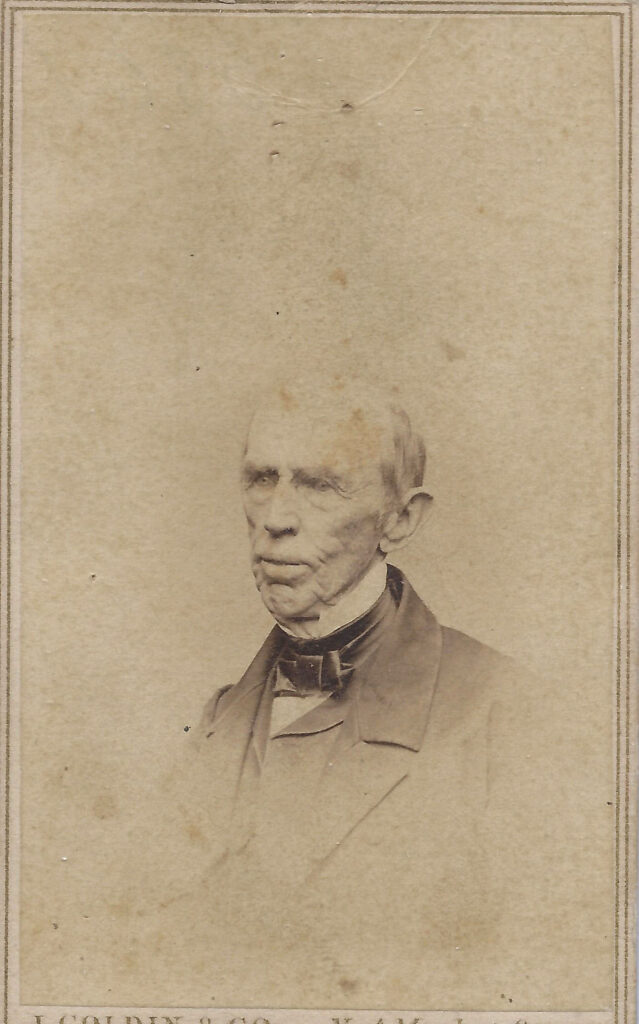
The Republican movement is just over eighteen months old when Francis Preston Blair, Sr. convenes a Christmas dinner meeting at his Washington D.C. home to discuss organizational strategy for the new party.
Old man Blair is a Southerner, a onetime member of Andrew Jackson’s “kitchen cabinet,” and for many years a king-maker within the Democratic Party. As such he seems an unlikely candidate to be hosting a Republican event.
But like his friend, Thomas Hart Benton, Blair is also a “reformed” slave holder, who turns on Pierce over the Kansas-Nebraska Act and now calls his old party:
A rotten organization composed and managed altogether by rotten men.
While Henry Seward declines Blair’s dinner invitation, other key founders attend. Chase is there, eager to share lessons learned from his “Ohio campaign” and to win the Republican nomination.
So too are fellow abolitionist colleagues, Senator Charles Sumner and Gamaliel Bailey, editor of the National Era — along with the Free Soiler, Preston King, and the rising House member, Nathaniel Banks, already gravitating toward a switch from the Know Nothings to the Republicans.
December 25, 1855
Salmon Chase Articulates His “Fusion Strategy” For The Party
At the session, the forever clever Salmon Chase touts his “fusion strategy” for the Republican Party.
Chase recognizes — based on his experiences with the Free Soil movement he founds in 1848 – that the number of Americans who oppose the spread of slavery on moral grounds is too small to win a national election.
He also believes that the Know Nothings face a similar barrier, with not enough voters driven by antipathy toward the Catholic immigrants.
However, Chase argues that, taken together, almost on a half and half basis, the “fusion” of these two groups should be sizable enough to elect the next president.
Assuming, of course, two other things: first, the right candidate, and second, a strong organization, especially across the dominant states in the North.
The right candidate must be someone sufficiently appealing to one constituency while not alienating the other. To satisfy the Republicans, this means someone who is not perceived to be too radically opposed to foreigners and Catholics. Among the Know Nothings, the choice must not be perceived as too “pro-Negro.”
Chase is convinced that he qualifies on both counts; others are less sure, given his well-known abolitionist stance.
The dinner ends with several important agreements:
- The Republicans will back Nathaniel Banks for Speaker of the House when the 34th Congress convenes;
- Efforts will be made to get Henry Seward and Thurlow Weed on board with future actions;
- A “mass organizational meeting” will be called on Washington’s birthday (February 22, 1856); and
- The likely site will be in the pivotal state of Pennsylvania, probably at Pittsburgh.
1856
Fred Douglass Criticizes The Republicans And Says Blacks Alone Will Earn Their Freedom
By the time Francis Blair holds his dinner, Frederick Douglass has become an acute observer of Northern attitudes toward slavery, among the politicians and public alike. Both, he decides, are far less concerned about ending slavery than about finally bringing the Southern “Slave Power” to its knees, by rejecting its self-serving efforts to enforce the Fugitive Slave Act and reverse the Missouri Compromise. And Douglas sees this same emphasis playing out within the new Republican Party.
The Republican Party is…only negatively antislavery. It is opposed to the political power of slavery rather than to slavery itself.
While “survey data” about public attitudes toward “slavery itself” are not available in the 19th century, a few anecdotal observations lend credence to Douglass’ assessment:
- In 1838 only 4% out the 6.0 million “base” of Northern whites over the age of 20 have joined a chapter of the American Anti-Slavery Society.
- In the election of 1844, less than 1% (62,000 of the 7.8 million base) vote for James Birney, the abolitionist candidate of the Liberty Party.
- During 1852 circulation of Stowe’s anti-slavery novel Uncle Tom’s Cabin reaches 1.5 million or roughly 15% of the now 10.1 million in the base.
On top of this are the repeated efforts by white Northerners to either “re-colonize” freed blacks or to segregate them in ghettoes or, finally, to write Constitutions – from Ohio through Indiana, Illinois, Kansas, Oregon and elsewhere – barring all negroes from taking up residence within state boundaries.
From the above, it seems fair to estimate that, at the time the Republican Party is born, fewer than one in four whites in the North (and almost none in the South) actively oppose what Douglass terms as “slavery itself.”
The question for him then becomes “what to do about this?”
In the early 1840’s he hopes, like Garrison, that the “moral suasion” in his lectures will be sufficient to win enough white converts. By 1850, he splits with Garrison and affiliates himself with Gerritt Smith and the New York abolitionists who seek solutions in politics and legislation.
As time passes, however, Douglass, like Lincoln, sees little hope that the majority of whites will ever support freeing the slaves, given the negative stereotypes of blacks ingrained in the culture.
Thus his famous argument that if blacks are ever to achieve freedom and justice in American society, it will because of their own efforts rather than any sudden burst of empathy and good will on the part of the white public or politicians.
Every day brings evidence…that our elevation as a race is almost wholly dependent upon our own exertions. If we are ever elevated, (it) will be accomplished through our own instrumentality.
Like Nat Turner and others before him, frustration soon lead him to supporting a violent insurrection at Harpers Ferry, as a member of the “Secret Six.” Ironically this landmark event will be carried out by his long-term white friend, “Captain” John Brown.