Section #1 - The American Civil War: 1861-65
Chapter 81: Lee Surrenders at Appomattox
The long and painful journey for Lee’s proud Army of Northern Virginia ends 33 miles west of Sailor’s Creek at Appomattox Court House. He arrives there with just under 40% of the soldiers it had on January 1, 1865.
Attrition of Lee’s NVA Army
| January 1, 1865 | April 9, 1865 |
|---|---|
| 69,659 | 27,000 |
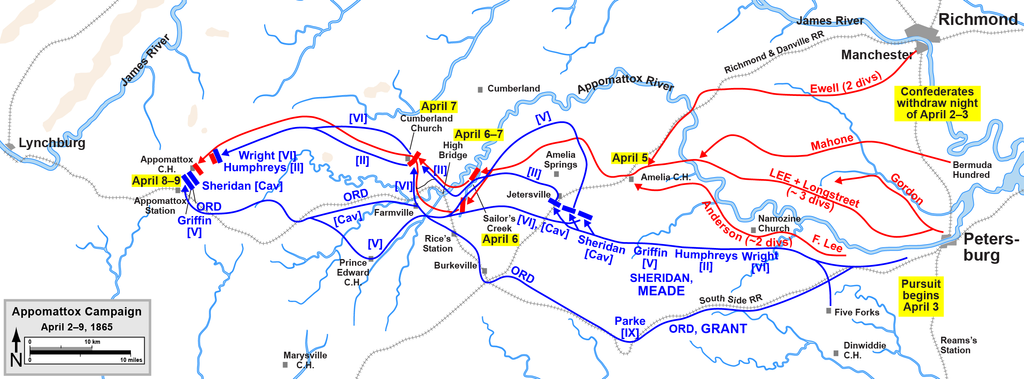
By Map by Hal Jespersen, www.posix.com/CW, CC BY 3.0, https://commons.wikimedia.org/w/index.php?curid=14748663
While “Marse Robert” still refuses to give up, the time for fighting has passed.
On April 7 Grant closes on him and sends a note under a white flag proposing a surrender to avoid the “needless effusion of more blood.” Lee consults with his remaining officers, among them General Gordon, his nephew and cavalry chief, Fitzhugh Lee, and his “old warhorse,” James Longstreet who, despite his long-time personal friendship with Ulysses Grant, tells Lee:
General, if he does not give us good terms, come back and let us fight it out.
On the afternoon of April 9, the two men meet at the home of Virginian Wilber McLean, who flees to Appomattox after his prior home is bombarded in 1861 on the 1st Bull Run battlefield. The 43 year old Grant arrives first, dressed in his characteristically disheveled uniform; the 59 year old Lee then appears in his finest grays, ram-rod erect with an elegant saber at his side. Both men feel awkward and briefly reminiscence about a prior meeting during the Mexican War. Then Lee asks Grant to write out the proposed terms of surrender in his own hand.
As a good will gesture, Grant insures Lee that his officers would not surrender their swords and that many of the men could keep their horses, baggage and side arms. Lee reads the document, signs it and shakes hands. All present tip their hats as he mounts up to bring the sad news to his soldiers.
Three days later the final ceremonies take place. After the Confederates stack their guns for the last time, the twice wounded Bowdoin professor, Joshua Chamberlain, orders a final “carry arms” salute to honor a worthy foe and begin the long road back to peace.