Section #1 - The American Civil War: 1861-65
Chapter 16: Grant Again Proves His Mettle at Shiloh
Two months after his triumph at Ft. Donelson, Grant is preparing for a planned advance on Corinth, Mississippi involving his Army of the Tennessee and Don Carlos Buell’s Army of the Ohio, a combined force of 65,000 soldiers.
On April 5, 1862, these troops are scattered across three places. Grant’s main body of 33,000 are at Pittsburg Landing. Buell’s 18,000 are 10 miles northeast around Savannah, Tennessee, close to Grant and his remaining 16,000 near Crump’s Landing.
At 5:00am on April 6, 1862, Grant hears ominous cannon fire coming from Pittsburgh Landing. He immediately orders two nearby Divisions to move to the front, and boards his Tigris steamboat to get there himself. But he doesn’t arrive until 9:00am. In the interim, his outnumbered army is being driven back to the river by the Confederate’s 45,000 troops under General Albert Sidney Johnston.
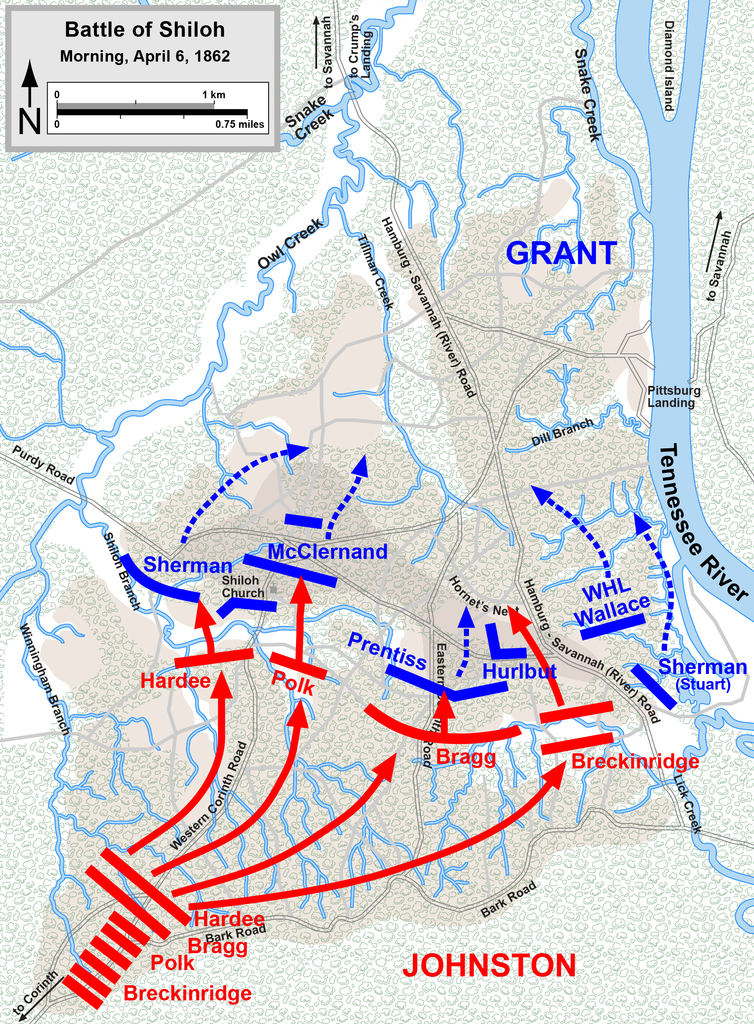
Map by Hal Jespersen, www.cwmaps.com, CC BY 3.0 https://creativecommons.org/licenses/by/3.0, via Wikimedia Commons
On the union right, rebel brigades under Generals Hardee and Polk force a frantic retreat by units under William Sherman and John McClernand near Shiloh Church. Braxton Bragg attacks the Union center at the “Hornet’s Nest,” and John Breckinridge hammers the left under WHL Wallace. By the time Grant appears, most of his troops are arrayed along the bluff at Pittsburg Landing or even straggling on the shoreline.
It is a moment of desperation, but stalls around 2:00pm when a bullet strikes the heroic A.S. Johnston in the artery of his right leg and he bleeds out for the lack of a timely tourniquet – thus becoming the highest ranking Grey officer killed in action during the entire war.
Just before 3:00, the USS Tyler arrives at the battlefield, raising morale by bombarding the Confederate positions. An hour later fighting intensifies at the Sunken Road fronting the “Hornet’s Nest.” One casualty there is General WHL Wallace who is shot in the head and dies around 4:00pm.
Defense of the Union center buys time for Grant to form a solid defensive line north of Pittsburg Landing and by 6:00pm Johnston’s successor, General Beauregard, calls off the first day of combat, while confident of a decisive win on April 7.
Grant, however, is convinced that the rebel army is fought out, and he prepares for a full scale offensive. During the night Union reinforcements arrive: 5,800 under Lew Wallace and the full 18,000 under Buell. Meanwhile rebel hope for support from Earl Van Dorn’s army vanishes.
At 5:00am the Blue offensive begins, with Buell to the east and Grant to the west. Bloody combat follows with the Confederates falling back throughout the day until Beauregard decides to call off the fight and escape south around 2:00pm.
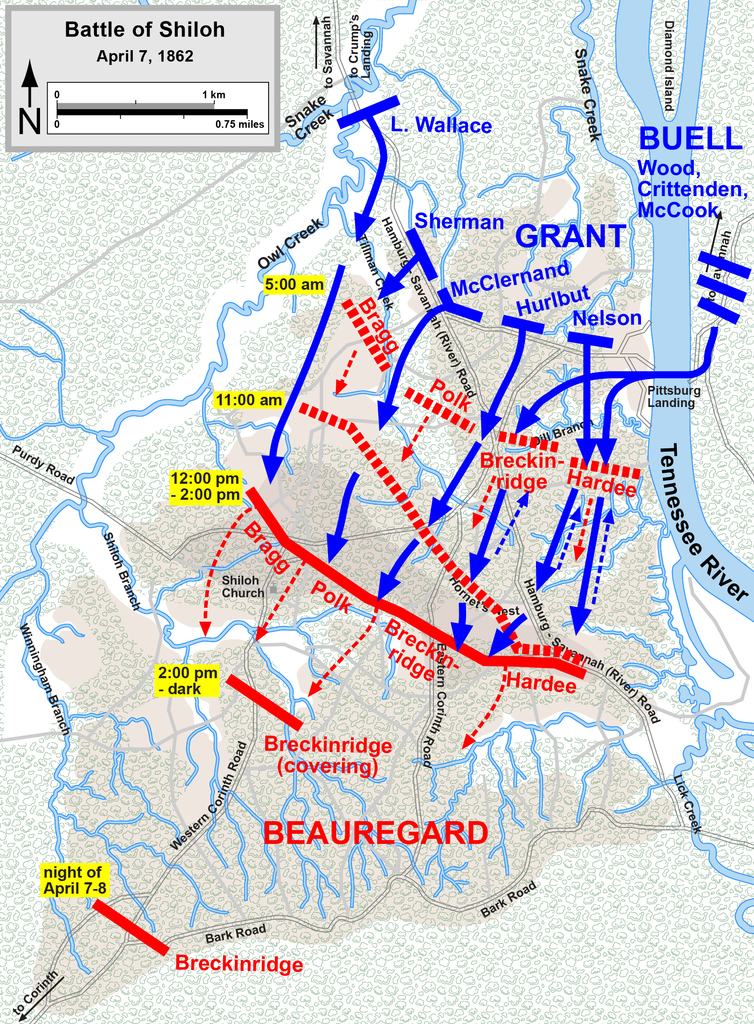
Map by Hal Jespersen, www.cwmaps.com, CC BY 3.0 https://creativecommons.org/licenses/by/3.0, via Wikimedia Commons
Casualty figures at Shiloh shock the nation. The North loses 13,047 total casualties; the South, 10,699. This total belittles the combined 3,700 lost at the “first great fight” at I Manassas, and makes Shiloh the 7th costliest battle of the entire war.