Section #1 - The American Civil War: 1861-65
Chapter 63: A Surprise in the Valley Threatens Washington
With Grant at Petersburg and Sherman heading toward Atlanta, Lee detaches Jubal Early to execute an end run up the Valley toward DC. In so doing he hopes to force Grant to transfer some of his attacking troops back north to defend the capital,
Early ascends the Shenandoah range and crosses into Maryland on July 5 with some 16,000 troops. He moves east through Hagerstown and Frederick, collecting ransoms to forego destruction of each city.
As he approaches Monocacy, about 50 miles west of Washington, the only Federals in his path are 2,300 inexperienced troops under General Lew Wallace. But this changes on July 8 when James Rickett’s arrives with 3,300 men. Together their task is to repulse, or at least delay, a two day march by Early on the capital.
Wallace aligns his forces east of the Monocacy River, intending to protect all bridges and fords.
Early counters by sending General John McCausland’s 1,100 cavalrymen south of the Georgetown Pike Bridge where he successfully fords the river before being stopped cold by Rickett’s skirmishers.
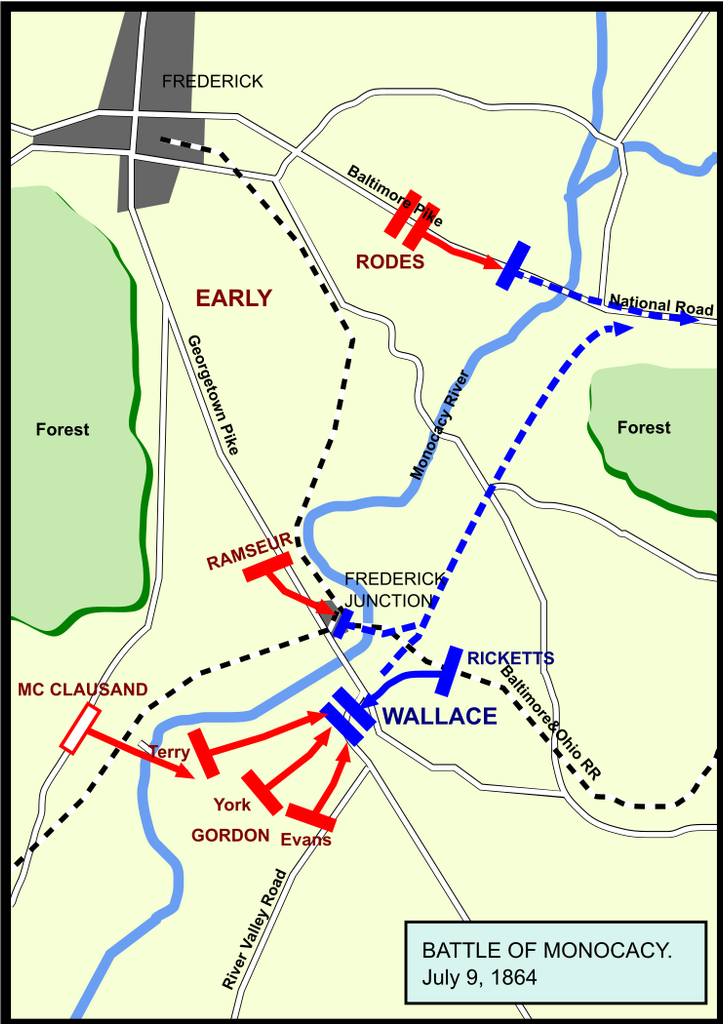
Map by ArdadN, via Wikimedia Commons. Public domain
Early then sends infantry under John B. Gordon that make five attacks before crushing the Union resistance and convincing Wallace to retreat toward Baltimore.
Casualties at Monocacy are 1,294 for the Blues versus roughly 850 for the rebels.
When Grant hears that a large contingent of Confederates are approaching Washington, he relieves Wallace and hands the defense over to Major General E.O.C. Ord who is stationed at Ft. Stevens. Grant also orders up VI Corps reinforcements who travel by steamboat from Petersburg.
On July 11 Early’s soldiers are within sight of the capitol dome but also exhausted after the battle and the long march to get there. He ponders an immediate attack on DC before delaying it to July 12 when skirmishes occur at Ft. Stevens, with President Lincoln in attendance and momentarily under fire.
But by then it is too late. With the VI Corps additions, the Union defenders now outnumber the 8,000 troops that Early has left to muster. Recognizing this he ends his campaign and heads back across the Potomac into the Shenandoah on July 14, 1864.
In hindsight, the raid on DC represents the Confederates last desperate attempt to penetrate the north and relieve pressure on Petersburg and Atlanta. It is an heroic effort, but fails to do so.