Section #1 - The American Civil War: 1861-65
Chapter 45: Rosecrans Is Routed at Chickamauga
Fresh from the victorious Tullahoma campaign, General Rosecrans is ordered to capture Chattanooga and open the door to a federal move into Georgia. He succeeds on September 9 after Thomas’ XIV Corps and Crittenden’s XXI Corps cross the Tennessee River and a reeling Bragg abandons the city, heading southeast across the border to the town of Ringold.
Although Bragg still has some 52,000 troops, he calls for reinforcements, and his lifelong, loyal friend, Jefferson Davis, complies. First he sends 17,800 men from Knoxville under Simon Bolivar Buckner, albeit one more subordinate who, based on Perryville, regards Bragg as incompetent. Davis also takes the extraordinary step of ordering two Divisions from Lee’s army in Virginia under General James Longstreet to begin marching toward Bragg.
Confederate Order of Battle at Chickamauga
| Corps | Divisions | Brigades |
|---|---|---|
| Polk | Cheatham Hindman | Jackson, Smith, Maney, Wright, Strahl P. Anderson, Deas, Manigault |
| D.H. Hill | Cleburne Breckinridge | Woods, L. Polk, Deshler Helm, Adams, Stovall |
| Buckner | A.P. Stewart Preston | Bate, Brown, Clayton Gracie, Kelly, Trigg |
| Walker | Walker Liddell | Ector, Wilson Govan, Walthall |
| Longstreet | B. Johnson Law | Fulton, Gregg, McNair Robertson, Sheffield, Benning |
| Forrest’s Cavalry | Armstrong Pegram | Wheeler, Dibrell Davidson, Scott |
On the morning of September 18, Bragg’s has his men lined up just across the Georgia border and east of the Chickamauga Creek, a natural barrier. But he has no intention of fighting on the defense. Rather he is determined to have his revenge against Rosecrans.
The Union army approaching from the west comprises three infantry Corps and a Reserve, along with Cavalry and artillery units.
Union Order of Battle at Chickamauga
| Corps | Commander | Divisions | Brigades |
|---|---|---|---|
| XIV | Thomas | Baird, Negley Brannan J. Reynolds | Scribner, Starkweather, King Beatty, Stanley, Sirwell Connell, Croxton, Van Derveer Wilder, King, Turchin |
| XX | A. McCook | Davis Johnson Sheridan | Post, Carlin, Heg Willich, Dodge, Baldwin Lytle, Laiboldt, Bradley |
| XXI | Crittenden | Wood Palmer Van Cleve | Buell, Wagner, Harker Cruft, Hazen, Grose Beatty, Dick, Barnes |
| Res. | Grainger | Steedman D. McCook | Whitacre, Mitchell McCook |
| Cav. | Mitchell | E. McCook Crook | Campbell, Ray, Watkins Minty, Long |
The battle opens on September 18 when Bushrod Johnson accidently encounters one of Crook’s cavalry units under Colonel Robert Minty on the rebel’s far right flank. Minty holds off Johnson while backtracking toward the Union base along the Lafayette Road. At about the same time, Blue Colonel John Wilder, with his Spencer repeating rifles, is being called upon to fight off an attack by Major General William Walker further south.
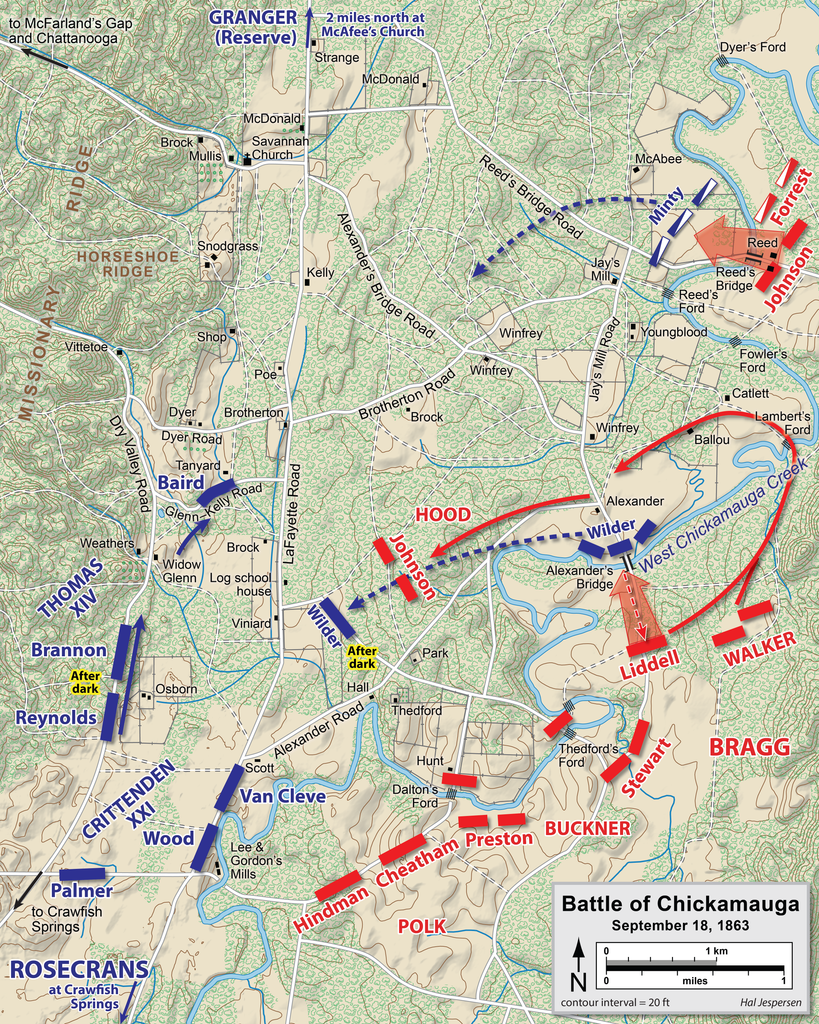
Map by Hal Jespersen, www.posix.com/CW. Licensed under CC BY 3.0
By sunset Rosecrans senses that he is facing a serious threat, and orders XIV commander George Thomas to begin September 19 by securing the Lafayette Road heading north to Chattanooga as a possible line of retreat. This puts Thomas in charge of the Union left flank which will bear a large brunt of Bragg’s blows over the next two days.
The rebels come at Thomas from every direction. To the north it is Nathan Forest’s Cavalry that tears into John Brannon’s Third Division under Colonels John Croxton and Ferdinand Van Derveer. St. John Liddell’s and Benjamin Cheatham assault Absalom Baird’s men along Brotherton Road, and Benjamin Cheatham drives in that same area against John Palmer’s Division.
The Union center is also tested in the afternoon of September 19. Around 3:30pm, A.P. Stewart hurls General William Bate’s brigade against Horatio Van Cleeve, reaching the Lafayette Road before being turned back for lack of reinforcements. Further south, the earliest arrival from Longstreet’s Corps, John Bell Hood attacks Wilder and Jefferson C. Davis across from the Brock Field and the Viniard House. The combat lasts until nightfall.
Casualties for the day stand at 7,000 Union and around 7,500 Confederates. Gray Generals Preston Smith and James Deschler are killed in action. Blue losses include four Colonels: Hans C. Heg, William Carroll, William Jones and Philemon Bldwin.
General Longstreet finally arrives around 11:00pm on September 19 and is informed by Bragg that he will take charge of the army’s Left Wing – while the Right is consolidated under Polk, including troops from DH Hill, Walker and Cheatham.
Much to Bragg’s dismay, Polk’s attack on Thomas and the Union left doesn’t begin until 11:00 am on September 20, by which time some rudimentary defensive entrenchments are in place. Breckinridge is first in, followed by Liddell. Negley’s Division is able to hold, but then Thomas sends a fateful message to Rosecrans requesting reinforcements.
The response to this request which arrives at John Brannan’s HQ has a catastrophic effect on the Union center which is currently being held by three side-by-side Divisions:
Brannan knows that if he were to shift his entire Division north to help Thomas, it would leave a potentially perilous gap between Reynolds and Wood. While Reynolds approves the move, Brannan sends a message to Rosecrans seeking his guidance. The confusing response, written by an aid, assumes that Brannan has already left the line, and orders Wood to close the gap with Reynolds.
When Wood receives the order, he is perplexed since Brannan has not departed. So to comply, Wood has his men reverse face and march behind Brannan and toward Reynolds.
As feared, this shift opens a path for Longstreet’s troops to crash across Lafayette Road and create a panicked flight by the Blue defenders. The rush is initially led by Hood who is shot in the right leg, which will be amputated just below the hip.
Most astonishing is that the Union flight includes Rosecrans himself! He sends James Garfield to tell Thomas that he has exited the field and retreats around 12:00pm along the Dry Valley Road and back to Chattanooga. Which leaves an isolated Thomas with around 13,000 men to face Polk’s repeated attacks.
But Thomas rallies his troops, dropping back west from Kelly Field and across the Lafayette Road to create a strong defensive position on Snodgrass Hill which rises some 350 feet above the approaches. He holds on throughout the afternoon, aided by the fact that troops from Longstreet’s command do not appear until 4:30pm. When night falls, Thomas slips away across Horseshoe Ridge having earned his lasting nickname as The Rock of Chickamauga.
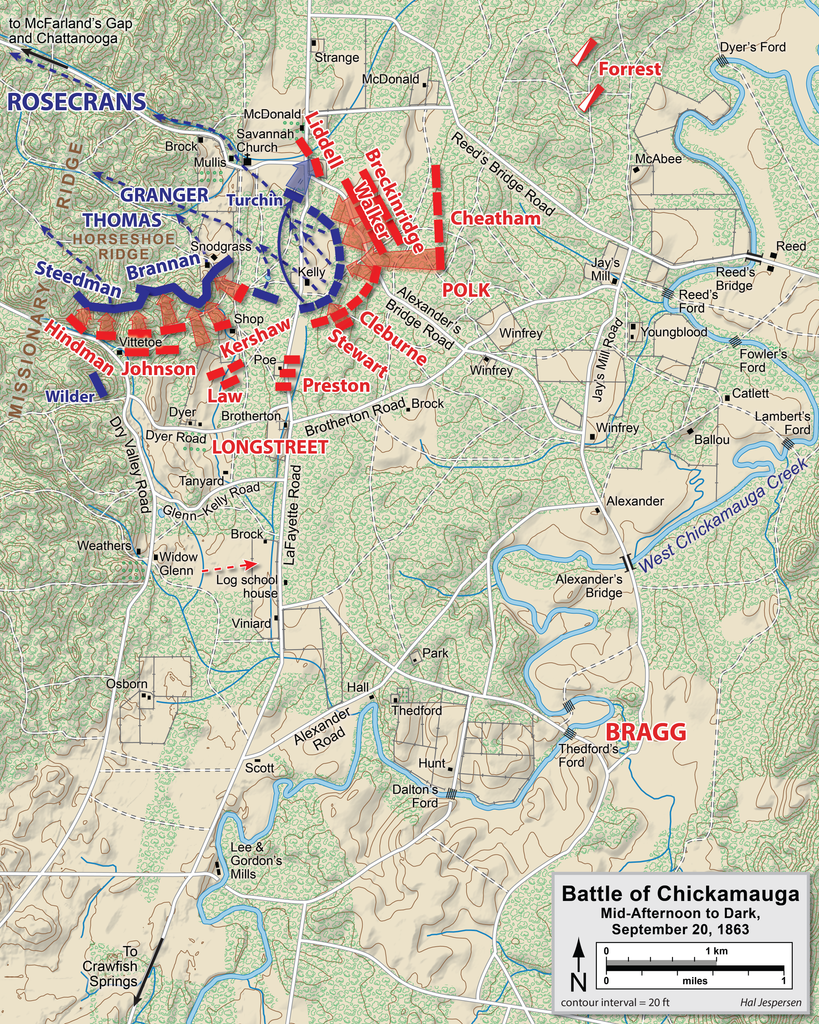
Map by Hal Jespersen, http://www.posix.com/CWmaps/
Licensed under CC BY 3.0
Bragg has defeated Rosecrans at Chickamauga, but hasn’t destroyed his army.
Total casualties make this the second bloodiest battle of the entire war, trailing only Gettysburg. The Confederates lose 18,450 and the Union 16,173. Notable victims on September 20 include Union Brigadier William Lyttle who falls during Longstreet’s attack and Benjamin Helm, commander of the Kentucky “Orphan Brigade” and brother-in-law to President Lincoln.
While Lincoln consoles Rosecrans, Grant selects Thomas to head the Army of the Cumberland Chickamauga on October 19, 1863.