Section #1 - The American Civil War: 1861-65
Chapter 21: The Peninsula Campaign Ends in Disaster
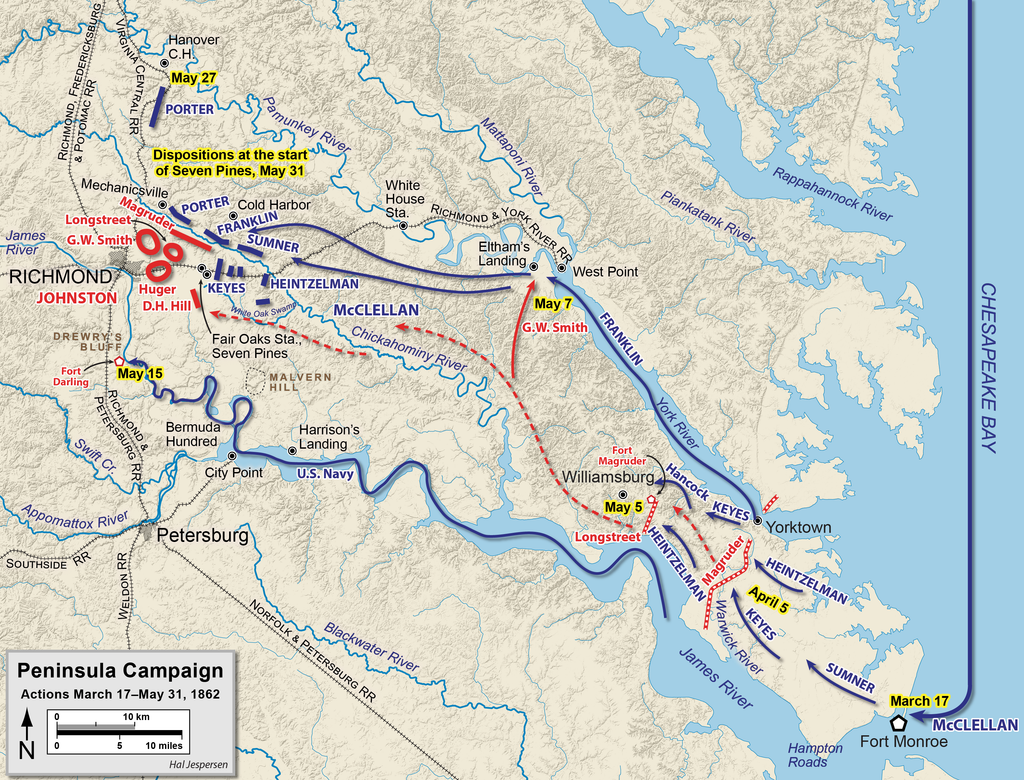
Upon arriving, McClellan learns that naval gunboats will be unable to support him on both the James and York Rivers, and he decides to move overland to the east of the Chickahominy River behind his three Corps commanders: II Corps (Edwin Sumner); III (Samuel Heintzelman); and IV (Erastus Keyes). When he is informed that Lincoln has ordered his I Corp (Irwin McDowell) to hold near Washington, he begins his refrain of being outnumbered by the enemy.
The Union begins its march up the Peninsula, arriving at Yorktown on April 5, where Confederate General Magruder has prepared a ruse defense by shifting his 12,000 troops from place to place. The over cautious McClellan backs off and settles on a siege which will involve 80,000 men and last for a month before the rebels fade back to Williamsburg on May 4. A pitched battle ends there on May 5 followed by a smaller skirmish at West Point on the York River. On May 15, the Union Navy’s attempt to bypass Drewry’s Bluff on the James with 5 ships, including 3 ironclads, is turned back. Six weeks are now gone and McClellan shifts his focus to threatening Richmond from the north and east.
The first Union strike occurs southeast of the capital on May 31 at Seven Pines. In the largest encounter of the war to date, with 11,500 casualties, the outcome is inconclusive, save for one propitious event. Around dusk, commanding General Joseph Johnston is struck in the right shoulder by a bullet and in the chest by a shell fragment, and carried off the field unconscious. His replacement is Robert E. Lee.
The Early Engagements in the Peninsula Campaign
| Date | Battle | Victory | Union Troops / Casualties | CSA Troops / Casualties |
|---|---|---|---|---|
| April 5 | Yorktown Siege | Inconclusive | 80,000 – 182 | 12,000 – 300 |
| May 5 | Williamsburg | Inconclusive | 15,000 – 2,283 | 13,750 – 1,682 |
| May 7 | West Point | Inconclusive | 11,300 – 194 | 11,000 – 48 |
| May 15 | Drewry’s Bluff | CSA | 5 ships – 27 | Artillery – 15 |
| May 31 | Seven Pines | Inconclusive | 34,000 – 5,431 | 39,000 – 6,134 |
Hlj, CC BY-SA 4.0 https://creativecommons.org/licenses/by-sa/4.0, via Wikimedia Commons
After Seven Pines, McClellan again sits passively for a full month, still convinced that he is undermanned. Lee seizes this lull to plan a counter offensive that history will label as the Seven Days Battles.
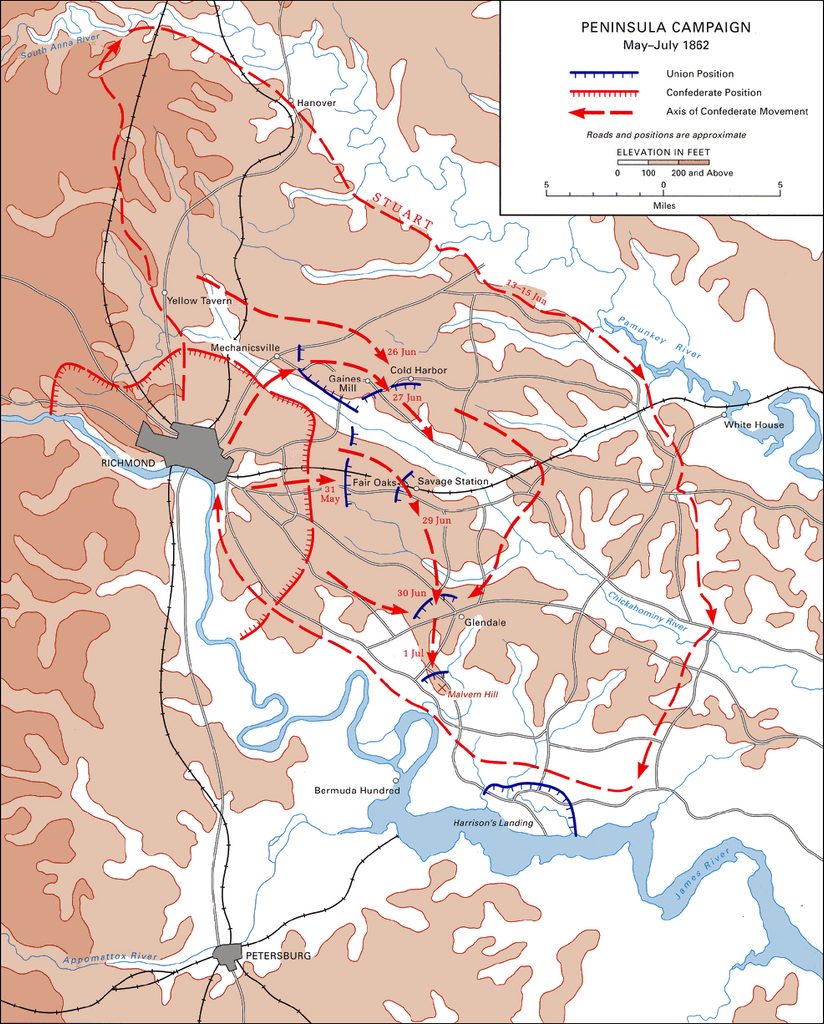
Despite the arrival of Stonewall Jackson’s troop after his Shenandoah campaign, the effort begins inauspiciously on June 26 with a loss north of Richmond at Mechanicsville. But then comes the decisive Confederate victory at Gaines Mill on June 27.
Here indeed McClellan is outnumbered with Lee assembling 57,000 troops to assault the Union’s awkwardly divided defense, with 10,000 men just north of the Chickahominy River and another 22,000 to the south. The fight goes back and forth until 7:00pm when Lee sends General John Bell Hood’s Texans in for what stands as the largest charge of the war, even surpassing Pickett at Gettysburg. Fitz John Porter’s Division is overrun and at 4:00am on the 28th, he burns the bridges on the Chickahominy and a full-scale Union retreat gets underway, heading south along James River.
The Seven Days Battles Commence
| Date | Battle | Victory | Union Troops / Casualties | CSA Troops / Casualties |
|---|---|---|---|---|
| June 26 | Mechanicsville | Union | 15,631 – 361 | 16,356 – 1,484 |
| June 27 | Gaines’ Mill | CSA | 32,214 – 7,337 | 57,018 – 7,993 |
After Gaines Mill, the race is on, with Lee’s army chasing the Union retreat. The first encounter takes place six miles south at Savage’s Station on June 29, where John Magruder vexes a much larger Blue rearguard comprising elements of all three Corps. McClellan moves another 10 miles south on July 30 to Glendale where Lee’s ambitious plan for a decisive envelopment fails to materialize. The Union then back peddles 4 more miles to the high ground at Malvern Hill where a set piece battle rages on July 1.
McClellan entrusts the field to Fitz John Porter while he journeys to his ultimate destination at Harrison’s Landing. Porter enjoys superior battery power led by Colonel Henry Hunt, and he uses it to beat back Lee’s infantry advances throughout the day. The action runs from 1:00 to 8:30pm, with sizable losses on both side.
The Seven Day’s Battles and McClellan’s Retreat
| Date | Battle | Victory | Union Troops / Casualties | CSA Troops / Casualties |
|---|---|---|---|---|
| June 29 | Savage’s Station | Inconclusive | 26,000 – 1,038 | 14,000 – 473 |
| June 30 | Glendale | Inconclusive | 40,000 – 3,797 | 45,000 – 3,673 |
| July 1 | Malvern Hill | Union | 54,000 – 3,007 | 55,000 – 5,650 |
On July 2, McClellan’s army completes its final 11 mile move to safety at Harrison’s Landing. Roughly 100,000 troops bivouac there over four weeks until August 3, when General Halleck orders them to disembark. Casualties during the 4 month campaign total 23,500 for the Union and 29,300 for the rebels.
Richard W. Stewart General Editor, Public domain, via Wikimedia Commons