Section #1 - The American Civil War: 1861-65
Chapter 26: The Confederate Offensive Ends at Antietam
Meanwhile as Lee marches across Maryland he is disappointed to find that the local support he anticipated fails to materialize. Worse yet, on September 13 a soldier in an Indiana regiment heading toward Sharpsburg spots an envelope on the ground containing three cigars wrapped in a copy of Lee’s “Order 191” detailing his plan for the campaign.
But when Lee appears west of Antietam Creek on September 15, the ever cautious McClellan, pauses at the peak of his advantage, letting September 16 slip away.
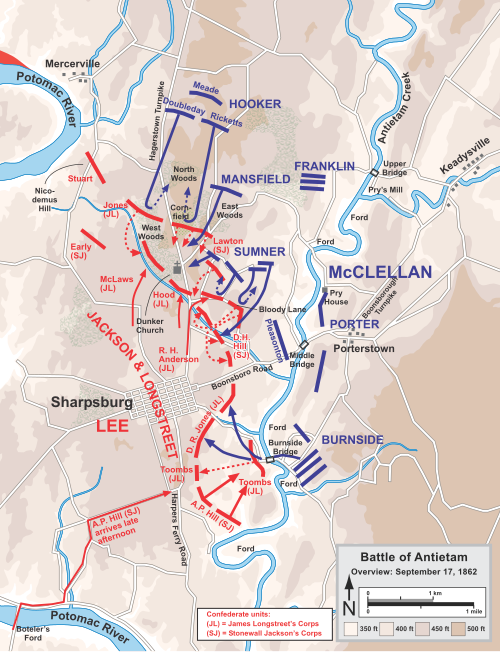
September 17 opens with Lee’s 38,000 troops arrayed in the West Woods along a line west of Hagerstown Pike and north of the Dunker Baptist Church. Meanwhile Little Mac has clumsily spread his six Corps and 70,000 men across three widely separated locations, thus forcing each to act independently and out of easy touch throughout the day.
Westwood Pike
| Forces / Formations |
|---|
| I Corps (Hooker) |
| XII Corps (Mansfield) |
| VI Corps (Franklin) |
| Lee’s defenders |
| II Corps (Sumner) – Richardson/French |
| II Corps (Jackson) |
| V Corps (Porter) |
| I Corps (Longstreet) |
| XI Corps (Burnside) |
The battle begins at 5:00am with General Joseph Hooker’s 8,000 I Corps men sweeping down from the North Woods and into David Miller’s 24 acre Cornfield, as the two sides begin to exchange artillery fire. With corn stalks rising above most soldier’s heads, and accompanied by battery smoke, chaos reigns for the infantry. Joseph Mansfield’s XII Corps engages and several Blue units do advance into the West Woods and down to the Church, killing CSA General William Starke on their way. But then General Hood’s Texans rally, Hooker is wounded and leaves the fray, and Mansfield is killed, becoming the first of six Generals falling in action. By 9:00am, the action shifts across the Pike and to the west and south.
Here a mere 2,500 troops under Daniel Harvey Hill and Robert Rodes are dug in along an 800 yard sunken road later known as “Bloody Lane.” Coming at them will be two full Union Divisions from General Edwin Sumner’s II Corps: the Third, with 4,000 troops led by Samuel French; and the First, with 5,700 troops under Israel Richardson. McClellan holds Porter’s V Corps in reserve all day in case of a possible retreat.
Instead of one coordinated mass attack, the two Union Divisions come in fragmented waves, thus enabling the rebels to repeatedly resist from behind their Sunken Road breastworks. After French wears out his men, General Richardson arrives around 10:30am, and by noon, the Confederates are forced to fall back, leaving their General George B. Anderson dead in the trench. Richardson chases the retreat until battery fire from Longstreet stops the surge. Richardson himself is struck in the chest by a shell fragment and dies later, on November 3, of infection and pneumonia.
Once the Sunken Road defense collapses, the threat to Lee’s entire army accelerates, with all eyes turning to the southeastern end of the field where Burnside’s XII Corps, 12,500 strong, has been struggling since 10am to cross Antietam Creek. Ignoring an easy fording location nearby, Burnside makes four attempts to cross Rohrbach’s Bridge which is defended by the political General, Robert Toombs, and only 400 soldiers. Finally around 3:00pm, the Greys withdraw, and the XII Corps drives them to the edge of Sharpsburg. At which point, Lee is saved by the arrival of A.P. Hill’s 3,000 man Light Division after a 17 mile march from Harper’s Ferry.
General Isaac Rodman makes one final heroic charge against Lee before being stopped by a shot through the lung, which leads to his death thirteen days later. At 5:00 the Union begins falling back all the way to the site that will forever bear the name “Burnside’s Bridge.” Soon after, the sixth and final General Officer to fall will be Lawrence O’Bryan Branch of the 4th North Carolinians, picked off from long range by a federal sharpshooter.
Citypeek, CC BY 3.0 https://creativecommons.org/licenses/by/3.0, via Wikimedia Commons
Antietam will prove to be the bloodiest single day battle of the war, with casualties of 12,410 for the North and 10,316 for the South. Lee’s Army escapes across the Potomac on September 18, two weeks after his campaign begins. On November 7, Lincoln relieves McClellan, again citing his excessive caution in failing to defeat and then pursue the Confederates.
Henceforth, an aggrieved Little Mac will fade to the military sidelines before running for President as a Peace Democrat in the 1864 presidential election. Lincoln will later use the Union win at Antietam to bolster his January 1, 1863 Emancipation Proclamation.