Section #1 - The American Civil War: 1861-65
Chapter 27: Bragg’s “Heartland Campaign” Falls Short
Lee’s invasion of the North is intended to coincide with rebel offensives into Kentucky and Mississippi aimed at dampening Union advances, especially against Vicksburg and Chattanooga.
A two pronged surge into Kentucky begins on August 14, with Major General Kirby Smith’s 6,000 troops leaving Knoxville, Tennessee, and heading north toward the town of Richmond.
Two weeks later, on August 28, General Braxton Bragg’s Army of the Tennessee exits Chattanooga, crossing the Cumberland River, and heading north toward Louisville.
Smith reaches Richmond on August 30 and delivers the most lop-sided rebel victory of the war. Each side fields about 6,500 men, but the consistently brilliant Brigadier Patrick Cleburne (later known as “the Stonewall of the West”) crushes Union General “Bull” Nelson, capturing 4,303 defenders, and moving on to Louisville.
Before joining Smith there, Bragg’s men are delayed at Munfordville, Kentucky, boyhood home of CSA General Simon Bolivar Buckner who plays a primary role in the ensuing battle. The Union Army, under Colonel John Wilder, gathers at Ft. Craig a mile south of the town and across the Green River, where it guards the rail tracks of the Louisville & Nashville line. But Wilder’s 4,000 men are surrounded after three days by 16,000 Confederates and they surrender to Buckner and General James Chalmers at 2:00am on September 17.
Meanwhile, in Mississippi, General Sterling Price loses a preliminary battle at Iuka against General William Rosecrans, serving under U.S. Grant. The main event follows on October 3-4, 1862, as the rebels attempt to regain the rail junction at Corinth just four months after Beauregard was forced to surrender it to a siege on May 30.
The two sides are evenly matched with just over 20,000 troops apiece. Grant has constructed a powerful defensive posture at Corinth, with a string of battery units along the high ground near the Corona Female College. Van Dorn opens the fighting around 10:00am on October 2, crashing into Rosecrans’ defenders north and west of the city. By 1:30pm the Union’s Sixth Division under Brigadier Thomas Davies and the Sixth Division under Thomas McKean have given way before the Grays are stopped in hand-to-hand combat by Scotland-born General John McArthur’s men and artillery support from Battery Robinett.
October 3 opens on the Confederate left, north of Corinth, with a successful assault on Battery Powell. But a counter offensive by Rosecrans finally forces Van Dorn to retreat around 1:00pm.
Two weeks later comes the so-called Battle for Kentucky. After the rebel successes at Richmond and Munfordville, Don Carlos Buell leads his 55,000 man Army of the Ohio in an effort to oust Bragg’s force of 16,000. The critical collision occurs on October 18 some two miles north and northwest of the tiny town of Perryville (population 300).
Bragg enters the fray believing that the town is only lightly defended, and begins the fighting around 2:00am under General Leonidas Polk on the Union left. But Polk’s lack of progress leads Bragg to reshuffle his Divisions in the morning. During this lull, Buell’s full army arrives, with Alexander McCook’s I Corps on the left, Charles Gilbert’s III Corps in the center and Thomas Crittenden’s II Corp on the right. Buell himself is not present after being thrown from a horse.
It is not until 12:30pm that CSA General Benjamin Cheatham opens an artillery barrage preparing for another rebel advance on the Union left against the I Corps Colonel William Terrill. Led by Generals A. P. Stewart and George Maney, the rebels force a Union retreat during which Terrill is mortally wounded by shellfire.
With the Confederates controlling the Union left and center, the fighting shifts south with Bragg hoping to envelop entire enemy army. Despite loud fire, an environment quirk known as an “acoustic shadow” leaves Buell unaware of the threat. But while the Confederates gain sizable ground, by 5:00pm they are out of ammunition and energy, and the combat closes. While Perryville is recorded as a CSA victory, its strategic impact is nil, and Bragg retreats toward Knoxville.
Thus the “Heartland Campaign” ends after five key engagements.
Key Battles in the Heartland Campaign
| 1862 | Battle of | Victory | Union/CSA | Union Troops / Casualties | CSA Troops / Casualties |
|---|---|---|---|---|---|
| August 30 | Richmond, Ky | CSA | Nelson/Smith | 6,850 – 5,352 | 6,500 – 451 |
| Sept 17 | Munfordville | CSA | Wilder/Chalmers | 4,148 – 4,148 | 16,000 – 714 |
| Sept 19 | Iuka, MS | Union | Rosecrans/Price | 4,500 – 790 | 3,179 – 1,516 |
| Oct 3-4 | Corinth, MS | Union | Rose/Van Dorn | 23,000 – 2,520 | 22,000 – 4,233 |
| Oct 18 | Perryville, Ky | Draw | Buell/Bragg | 55,000 – 4,241 | 16,000 – 3,396 |
The Confederates have advanced from Chattanooga and Knoxville toward Louisville and from Memphis to Corinth over six weeks, only to be turned back with the Union still firmly in control of Kentucky and strengthened in Tennessee and Mississippi.
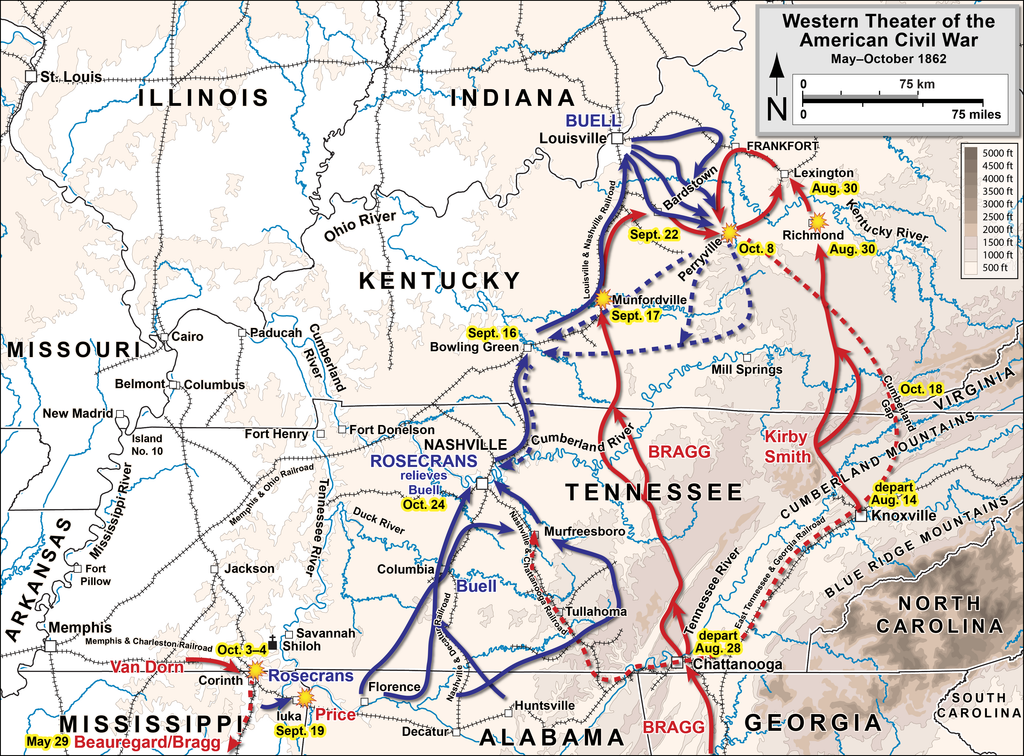
Map by Hal Jespersen, www.cwmaps.com, CC BY 3.0 https://creativecommons.org/licenses/by/3.0, via Wikimedia Commons
While roundly criticized by his Corps commanders, Jefferson Davis allows Bragg to keep his job. But not so for Don Carlos Buell who is replaced by General Rosecrans on October 24, 1862.