Section #1 - The American Civil War: 1861-65
Chapter 62: Sherman Moves South to Kennesaw Mountain
While the Confederate delay Sherman at the battle of New Hope, this doesn’t dampen his intent to move south rapidly. However eleven consecutive days of heavy rain do so, turning the roads into mud and disrupting all supply trains.
On June 14 he finally sets out with 16,000 troops heading toward Marietta, the pathway to Atlanta. Later that day Generals Johnston, Polk and Hardee are standing at an outpost on Pine Mountain when O.O. Howard’s passing artillery fires at them. One missile, a Parrott shell, strikes Lt. General and Episcopal Bishop Leonidas Polk, entering through his left arm and his body, killing him instantly.
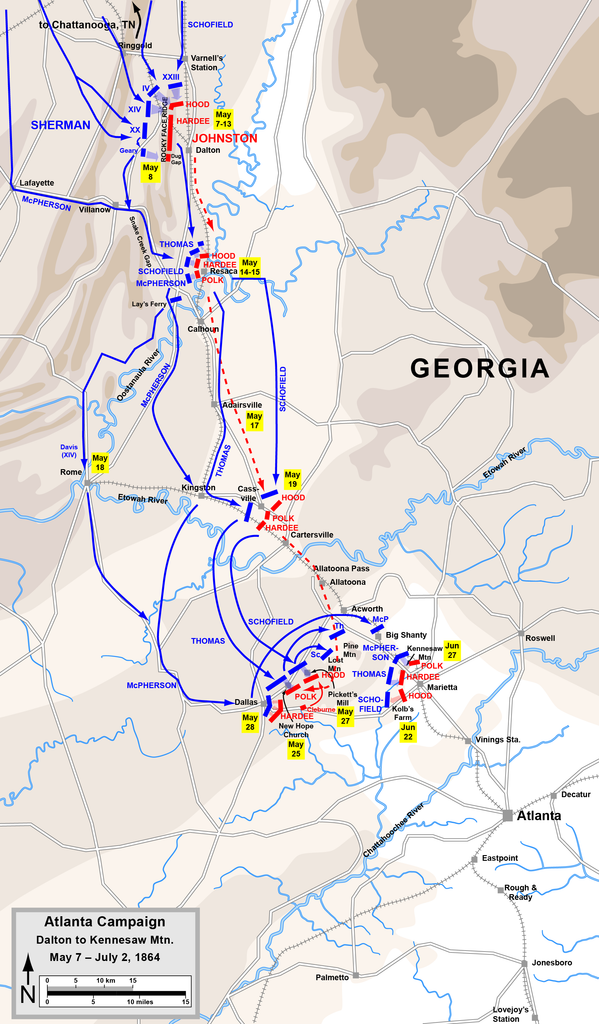
Sherman bypasses Pine Mountain and heads down the Stilesboro (Marietta) Road running parallel to the Western and Atlantic Railroad, reaching the outskirts of Kennesaw Mountain on June 19. The terrain is challenging, with swamps running through thickets of trees at the foot of the 1800 ft. high peak. Once there he places McPherson’s XVII Corps on his left flank, Logan’s XV Corps on his immediate right and John Schofield’s Ohio troops some 3 miles to the south.
Awaiting him is General “Wings” Loring, who succeeds the fallen Polk.
Initial skirmishes turn into a full-scale frontal assault by the Union at 8:00am on June 27. McPherson hits the Confederate right, while Logan aims a knock-out blow further south at Little Lookout Mountain. But Loring is fully able to hold his high ground and by 11:30 am the clashes end.
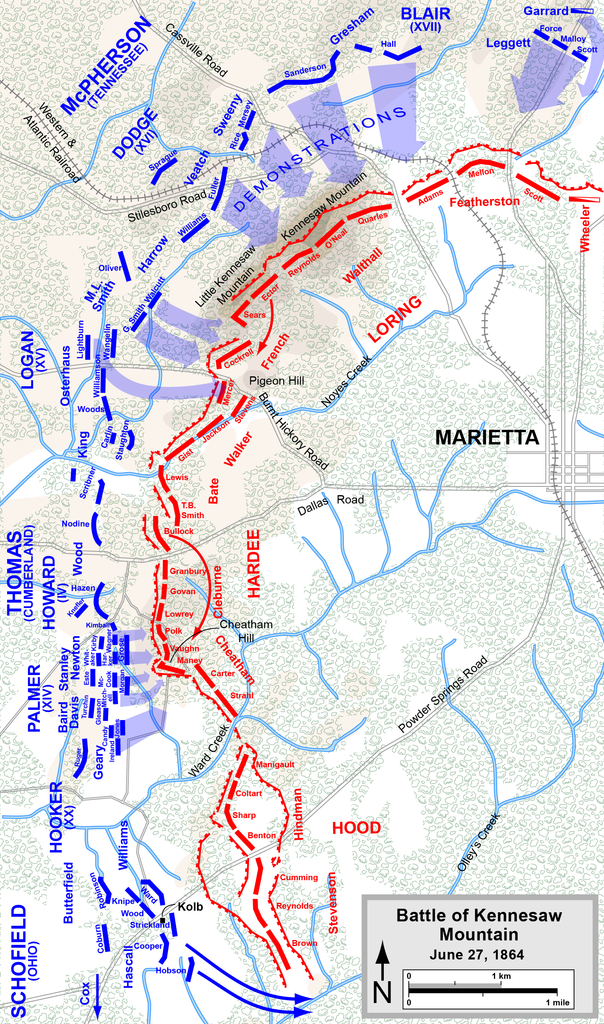
The only Union success for the day comes far down on the Confederate left where John Schoefield’s men break past Hood’s flank to threaten Loring’s rear. Further probes by General George Stoneman’s cavalry finally convince Johnston to retreat from Kennesaw Mountain and on July 2 he heads out toward Smyrna.
Casualties come to 3,000 for the attacking Blues and 1,000 for the defending Grays.