Section #1 - The American Civil War: 1861-65
Chapter 30: The Union Victory at Stone’s River, TN Marks the Final Battle of 1862
After the Perryville battle ends on October 18, both sides take a two month time-out to recover and reorganize. General Bragg moves 130 miles south to the city of Murfreesboro, joined by 35,000 men divided between Polk’s Corps and Hardee’s Corps. The Union forces, now titled the Army of the Cumberland, move to Nashville. Under their newly promoted commander, General William Rosecrans, they total 43,000 across three corps: the Right Wing (16,000/Alexander McCook); Center (13,000/George Thomas) and Left (14,000/Thomas Crittenden).
On December 26, 1862, the Union heads toward Murfreesboro, arriving there on the evening of December 29 and establishing a line west of the Nashville & Chattanooga Railroad. Polk’s Corp lies to their immediate south while Hardee lies to the east.
On December 31, both commanders are intent on attacking the right flank of the enemy. But Crittenden’s Wing has much further to march than Polk, and at 6:00am Generals John McCown and Arthur Manigault crash out of a cedar forest, surprising Blue troops under Philip Sheridan. Fortunately Sheridan is able to rally his men for over three hours, buying time for Rosecrans to start organizing a solid defense along the Nashville and Cumberland Pike, some three miles northwest of the town. With Rosecrans’ right flank stabilizing, Bragg decides to test the left, ordering John Breckinridge’s Division to cross Stones River around 4:00pm. But he is rebuffed by General William Hazen’s artillery brigade at the “Little Round Forest” later known as “Hell’s Half Acre.”
By 4:30pm Bragg has run out of options and the fighting ends for the day.
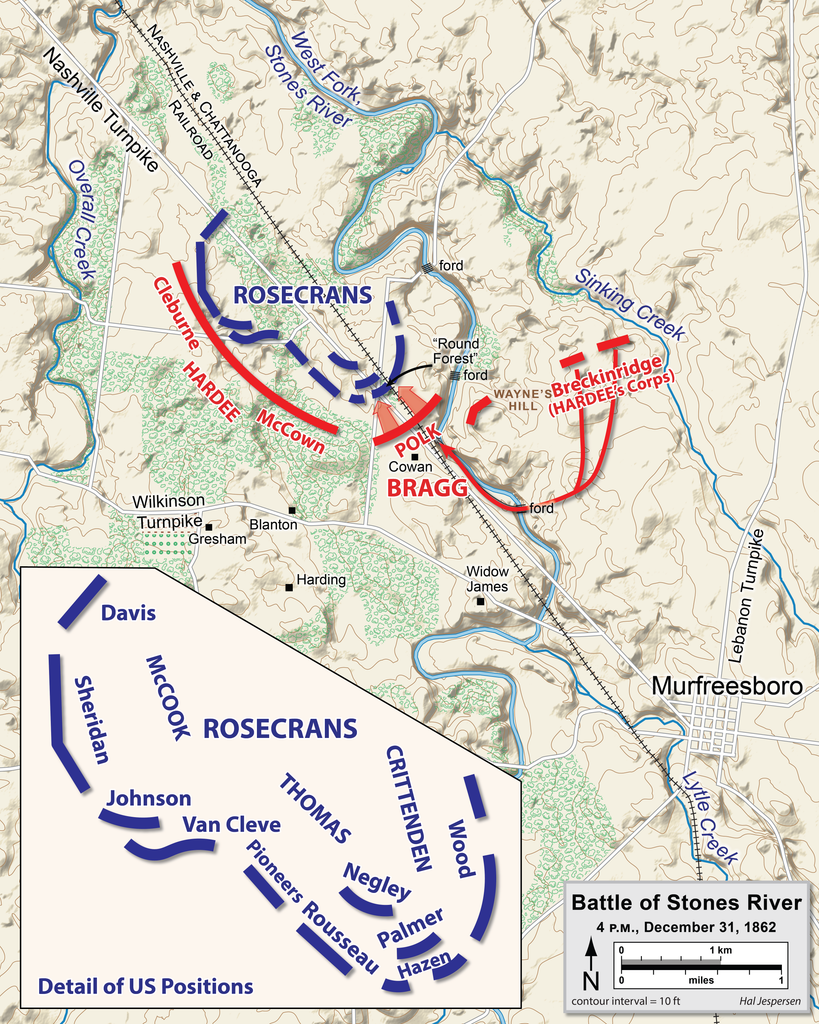
Map by Hal Jespersen, www.cwmaps.com, CC BY 3.0 https://creativecommons.org/licenses/by/3.0, via Wikimedia Commons
Neither side retreats and skirmishes continue into January 1- 2, 1863, amidst bitterly freezing rain. Bragg finally recognizes that the Union can bring up reinforcements while he cannot, and at 10am on January 3, he heads south through Murfreesboro on a 36 mile march to Tullahoma, Tennessee. Rosecrans is satisfied with the outcome and refuses to pursue him.
But the Battle of Stones River has been ferocious, setting the record across the entire war for the highest percentage of casualties/engaged: 34% for the CSA and 32% for the Union.
Important Battles: Second Half of 1862
| 1862 | Battle | State | Victory | K/W/C | Impact |
|---|---|---|---|---|---|
| May 31 – June 1 | 7 Pines | Va | Draw | 13,700 | CSA command passes to Lee |
| June 27 | Gaines Mill | Va | CSA | 15,500 | McClellan’s invasion fails |
| July 1 | Malvern Hill | Va | USA | 8,600 | Lee stopped before Union flees |
| Aug 28-30 | 2nd Bull Run | Va | CSA | 22,200 | The Union loses for a second time |
| Sept 12-15 | Harpers Ferry | Va | CSA | 12,900 | CSA takes control until Antietam |
| Sept 17 | Antietam | MD | USA | 22,700 | Lee’s first invasion north fails |
| Oct 8 | Perryville | Ky | Draw | 7,600 | Final blow to CSA in Kentucky |
| Dec 11-15 | Fredericksburg | Va | CSA | 17,900 | Burnside’s troops are slaughtered |
| Dec 31 – Jan 2 | Stone’s River | Tn | USA | 23,500 | Bragg withdraws after high losses |