Section #1 - The American Civil War: 1861-65
Chapter 40: Grant Captures Vicksburg
After two failed attempts to storm Vicksburg with his infantry, Grant decides to protect the lives of his men, and shift to laying siege on the city as of May 25. He enjoys a more than 2:1 manpower advantage, 77,000 vs. 33,000, and is also able to combine his land-based artillery with constant bombardments from his gunboat fleet along the Mississippi River.
But Pemberton counters with a nearly impregnable line of defense. The terrain leading to the city from the east is marked by steep up and down slopes fortified by felled trees and abates, rifle pits and concealed redoubts. Infantry approaches are also covered by a series of artillery batteries: Ft. Hill to the north; Stockade Redan in the center; and further south, the Railroad Redoubt and Ft. Garrott. While Pemberton’s 172 cannon are only marginally fewer than Grant’s 220, his inability to resupply ammunition will severely limit his firepower.
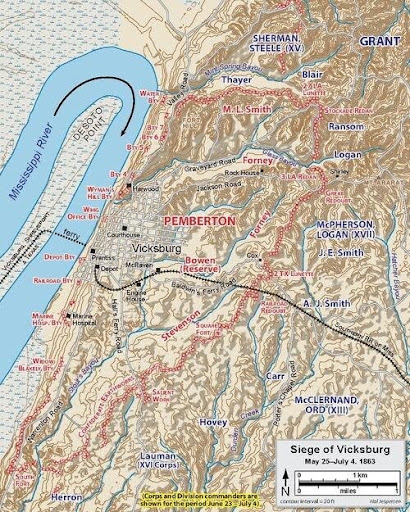
Once Grant has surrounded the city’s 6 mile defense perimeter, his strategy becomes simple: wear down all resistance by cutting off the supply of food, destroying houses and other shelters, and maintaining a steady beat of demoralizing bombardments.
People retreat into carved out caves (“bombproofs”) and starvation soon spreads. Reliance on horse and mule meat and garden vegetables gives way to dog meat, squirrels and even tree bark. Sanitary conditions break down followed by bouts of dysentery and malaria absent life-saving quinine.
The toll is evident in a memoir from resident Mary Ann Webster Loughborough who recounts her existence during the siege in a cave she shares with her daughter and husband:
The cave we inhabited was about five squares from the levee. Negroes hired
themselves out to dig them, at from thirty to fifty dollars, according to the size.
We could not tell in what terrible form death might come to us before the sun
went down. Another fear was that our provisions might not last us during the siege
(One) night was so warm, and the cave so close, that I tried to sit out at the
entrance. Soon the report of the gun would be heard…and I would spring to my
feet (back) to the protection of the cave. That night I could scarcely sleep, the
explosions were so loud and frequent.
And so the weary days went on—the long, weary days. God in his mercy helps
the poor human hearts that suffer, struggle, and grow strong in these sad years of
warfare! No one came now—no word to show that life still throbbed in the silent city.
After 45 days of punishment, Pemberton sends a note to Grant on July 3, 1863, asking for terms. This time Grants rejects unconditional surrender since it would require tying up his army to feed and imprison 30,000 rebel soldiers. Instead he paroles them all, assuming they are too wasted to rejoin the war. (In fact, most transfer east to defend Chattanooga in October 1863.)
The formal surrender takes place on July 4, one day after the Confederate loss at Gettysburg. Union troops enter the city at 10:00am, march to the courthouse and raise the American flag.
Casualties number 4,835 for the Union versus the Grays 3,202 killed or wounded plus 29,495 captured.