Section #1 - The American Civil War: 1861-65
Chapter 70: Hood Suffers a Disaster at Franklin
After escaping Atlanta on September 2, 1864, John Bell Hood heads north with his Army of Tennessee hoping that Sherman will chase him to protect his supply lines. But “Uncle Billy” chooses instead to head toward the Georgia capital at Milledgeville on what will become his famous March to the Sea.
Before he departs, Sherman assigns Commander of the Cumberland, George Thomas, to defend Tennessee against Hood’s wish to regain control of the state. Thomas has 27,000 men and two Corps at his disposal: the IV under David Stanley at Nashville and John Schofield’s XIII, 75 miles south at Ft. Pulaski.
Union Order of Battle at Franklin (November 30, 1864)
| Corps | Commander | Divisions | Brigades |
|---|---|---|---|
| IV | John Schofield | Kimball Wagner Wood Bridges – art. | Kirby, Whitaker, Grove Opdyke, Lane, Conrad Streit, Post, Knefler |
| XXIII | Jacob Cox | Ruger Reilly | Cooper, Moore, Strickland Casement, Stiles |
| Cav. | James Wilson | McCook Hatch Johnson | Croxton Stewart, Coon Capron, Biddle |
Hood sets out north on November 23 from Tuscombia, Alabama with his 29,000 men.
Confederate Order of Battle at Franklin, TN (November 30, 1864)
| Corps Commander | Divisions | Brigades |
|---|---|---|
| Benjamin Cheatham | Patrick Cleburne John Brown William Bate Melancthon Smith – art. | Lowery, Govan, Granbury, Smith Gist, Carter, Strahl, Gordon Smith, Bullock, Jackson Hoxton, Hotchkiss, Beauregard |
| Stephen Dill Lee | Edward Johnson Carter Stevenson Henry Clayton Robert Beckham – art. | Deas, Manigault, Sharp, Brantley Watkins, Pettus, Palmer Stovall, Gibson, Holtzclaw Douglas, Fenner, Johnston |
| Alexander P. Stewart | William Loring Samuel French Edward Walthall Samuel Williams – art. | Featherston, Adams, Scott Coleman, Cockrell, Sears Quarles, Shelley, Reynolds Truehart, Myrick, Storrs |
| Nathan B. Forrest – cav. | James Chalmers Abraham Buford William Jackson | Rucker, Biffle Bell, Crossland Armstrong, Ross |
His goal is to get between the two Union armies and beat each in detail. He believes he can do that by reaching Columbia, Tennessee, 85 miles away, before Schofield.
While the Blue troops arrive there first, Hood cleverly moves around their flank and sets up a trap 11 miles north at Spring Hill.
It is there that confusion reigns for the Confederates. Despite the presence of his full infantry and cavalry, Hood leaves the critical Columbia Pike unguarded. This allows a “muffled” nightfall march by Schofield which gets his entire Corps past the sleeping Grays at Spring Hill on November 29.
By 4:30am on the 30th they arrive at Franklin and set up a semi-circle of fortifications around the city, anchored on both flanks by the Harpeth River in their rear. Entrenchments from the prior 1863 battle are upgraded, often fronted by abitis.
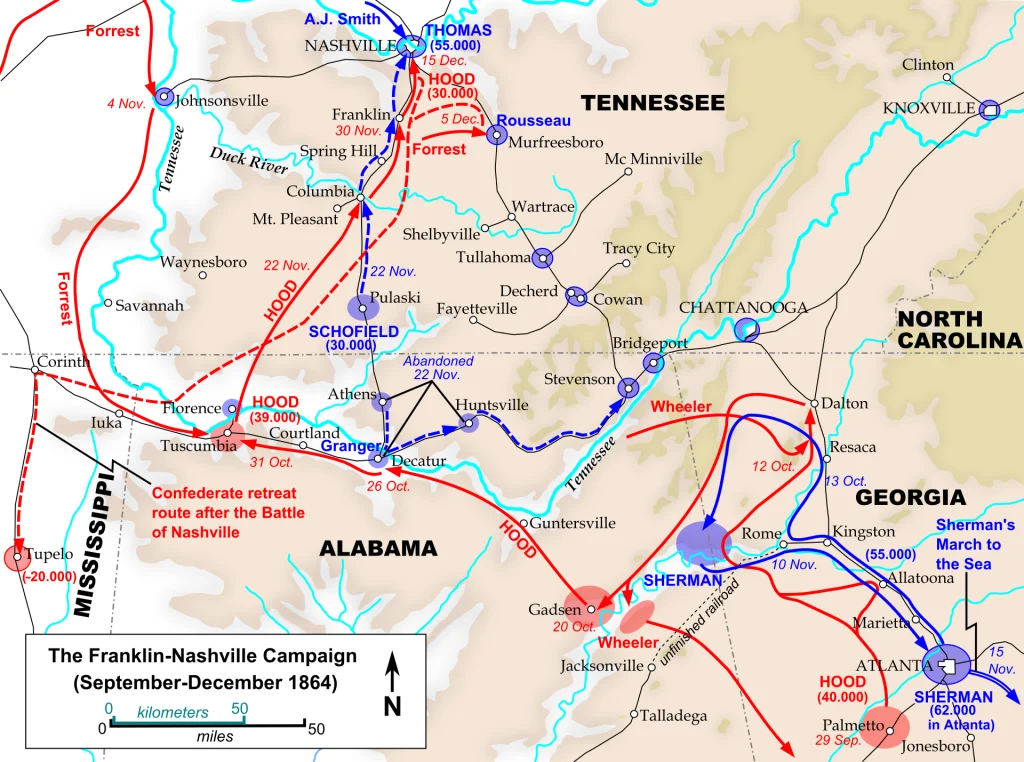
Map by Andrein, via Wikimedia Commons
Hood arrives at Franklin at 1:00pm, apparently in the grip of two emotions: fury for having failed to trap Schofield at Spring Green; and belief that his troops have gone soft, preferring to seek trenches for cover rather than stand up attacks like he himself led at Gaines Mill in 1862.
Despite pleas for restraint from his commanders, he orders a full out charge to reinstall elan.
The charge steps out a 4:00pm with the rebels running two miles across open fields of fire to reach the enemy. The sheer momentum causes a momentary breach in the Union center until Colonel Emerson Opdyke closes the gap. For this he is promoted to Brevet Major General.
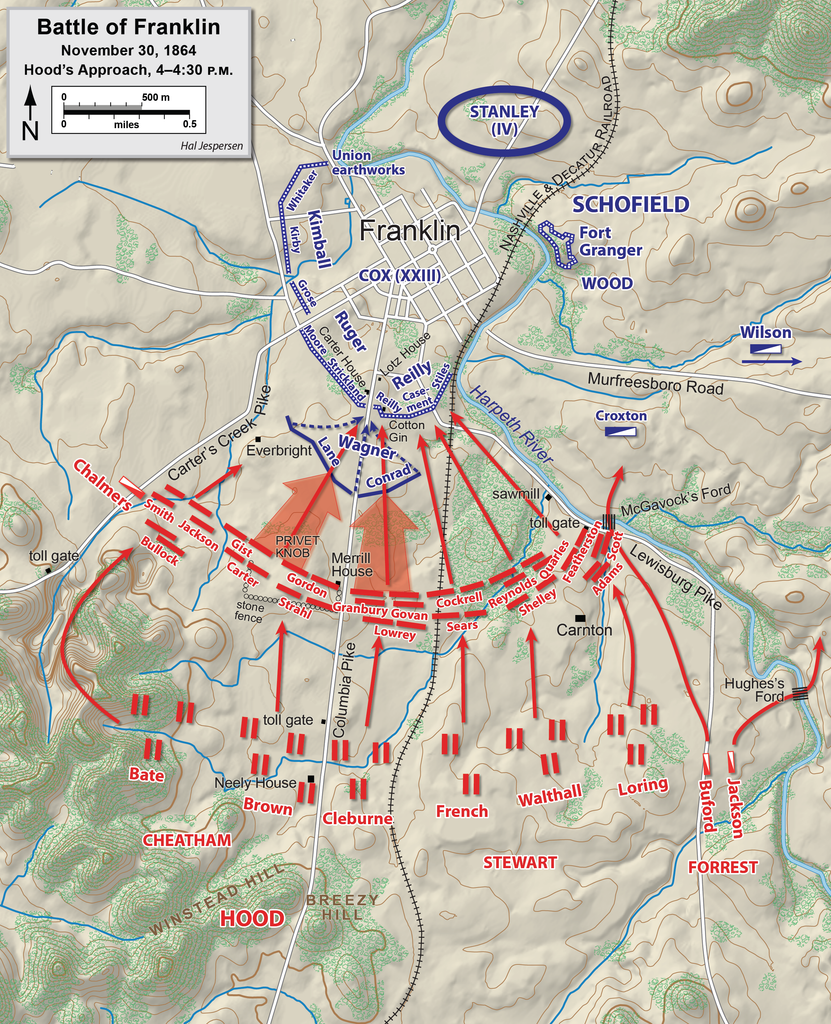
Map by Hal Jespersen, www.cwmaps.com, via Wikimedia Commons
The intense fighting ends around 7:00pm with some 6500 Gray casualties against 2,326 for the Federals. The losses, however, totally decimate the Confederate officer corps, with 6 Generals KIA and seven others wounded. Prior to burial, the first six are laid side by side on the back porch of the McGavock family home at Carnton.
Confederate Generals Killed at Franklin (November 30, 1864)
| Name | Rank | Age | Home | Married | College | Own Slaves |
|---|---|---|---|---|---|---|
| Patrick Cleburne | MG | 36 | Ireland | Engaged | None | No |
| John Adams | BG | 39 | TN | 4 children | West Point | No |
| John Carter | BG | 26 | Ga | Yes | UVA | No |
| States Rights Gist | BG | 33 | SC | Yes | Harvard Law | Yes |
| Hiram Granbury | BG | 33 | MS | Yes | Baylor | Yes – 2 |
| Otho Strahl | BG | 33 | Ohio | No | Ohio Wes. | No |
According to medical records, here is how each of the six die.
| Name | How Each Dies |
|---|---|
| Patrick Cleburne | Struck by a minie ball in the left side of his abdomen. |
| John Adams | Hit by nine bullets while on a horse which falls on him |
| John Carter | Mortally wounded, dying on December 10 |
| States Rights Gist | Shot in chest after dismounting and dies at field hospital |
| Hiram Granbury | A bullet strikes his face just under the right eye |
| Otho Strahl | Wounded in the neck before a fatal shot to the head killing him instantly |
Those wounded include Major General John Brown and six Brigadiers.
Seven CSA General Wounded
| Name | Rank |
|---|---|
| John Brown | MG |
| Francis Cockrell | BG |
| Zachariah Deas | BG |
| Arthur Manigault | BG |
| Thomas Scott | BG |
| Jacob Sharp | BG |
After Schofield retreats toward Nashville having avoided a scare, Hood rides into town in a delusional state, blaming the entire loss on executional failure of his commanders.
Rather than retreating he decides to doggedly continue his chase after Schofield.