Section #1 - The American Civil War: 1861-65
Chapter 61: Grant Keeps the Pressure on at Cold Harbor
Since the stand-off at The Wilderness, Grant has advanced nearly 70 miles south through Spotsylvania Court House and the North Anna crossing to reach Cold Harbor on May 31, only 12 miles northeast of Richmond.
He is accompanied by some 108,000 troops across five Corps, together with Cavalry and Artillery.
Union Order of Battle at Cold Harbor (May 31 – June 12, 1864)
| Union | Commander | Divisions | Brigades |
|---|---|---|---|
| Potomac | George Meade | ||
| II Corps | Winfield Hancock | Barlow Gibbon Birney Tidball art. | Miles, Byrnes, McDougall, Brooke McKeen, Owen, Smyth, Tyler Egan, Tannant, Mott, Brewster |
| Union | |||
| V Corps | Gouverneur Warren | Griffin Lockwood Crawford Cutler Wainwright art. | Ayres, Sweitzer, Bartlett Lyle, Bates, Dushane Hardin, Fisher, Kitching Robinson, Hoffman, Bragg |
| VI Corps | Horatio Wright | Neill Ricketts Russell | Wheaton, L. Grant, Bidwell, Edwards Truex, Smith, Tomkins art. Penrose, Upton, Eustis, Cross |
| IX Corps | Ambrose Burnside | Crittenden Potter Wilcox Ferrero | Pierce, Marshall Curtin, Griffin Hartranft, Crist Siegfried, Thomas |
| XVIII Corps | Baldy Smith | Brooks Martindale Devens | Marston, Burnham, Henry Stannard, Stedman Barton, Drake, Ames |
| Cavalry | Philip Sheridan | Torbert D. Gregg Wilson | Custer, Devin, Merritt Davies, J. Gregg McIntosh, Chapman |
| Artillery | Hunt | Ransom, McGilvery | |
Sheridan’s Cavalry arrives first, on May 31, and secures the crossroads at Old Cold Harbor, just south of the Beulah Church and east of the New Cold Harbor site. As they entrench along the Mechanicsville Road, the soldiers are shocked by turning up uniform clad skeletons left from the 1862 battle at Gaines Mill.
Lee is determined to dislodge the Blue toehold and brings up his full contingent of 60,000 troops. By this time, however, attrition has cost him his three most trusted commanders – Jackson, Longstreet and Stuart – and in their places he is left to rely on R. Anderson, Early and Hill.
Confederate Order of Battle at Cold Harbor (May 31 – June 12, 1864)
| CSA | Commander | Divisions | Brigades |
|---|---|---|---|
| I Corps | Richard Anderson | Kershaw Field Pickett Alexander | Keitt, Humphreys, Wofford, Bryan Bratton, Gregg, Law, G. Anderson, Benning Terry, Hutton, Barton, Corse Huger, Hascall, Cabell |
| II Corps | Jubal Early | Ramseur Gordon Rodes Long – art. | Pegram, Johnston, Hoke Evans, York, Terry Grimes, Bennett, Battle, Doles Hardaway, Braxton, Nelson, Page |
| III Corps | A.P. Hill | Mahone Heth Wilcox Walker art. | Sanders, Weisiger, Harris, Finegan, Wright Davis, Cooke, Fry, Kirkland Lane, Conner, Scales, Thomas Poague, Pegram, McIntosh, Miller, Cutts |
| Breckinridge | Echols, Wharton, Johnson, King | ||
| Hoke | Martin, Clingman, Hagood, Colquitt, Reed | ||
| Cavalry | Hampton Fitz Lee W.H.F. Lee Chew – art. | Wright, Rosser, Butler Lomax, Wickham Chambliss, Gordon Breathed |
On June 1, the Confederates align along a seven mile front with Cold Harbor on their far right flank.
At dawn, Anderson orders Laurence Keitt, the ex-Congressman and “fire-eater” from South Carolina, to attack Sheridan’s cavalry. But Keitt is mortally wounded and Colonel Brigadier Wesley Merritt is able to hold the rebels off.
By 9:00am the worn out Union cavalry is reinforced by the arrival of Horatio Wright’s VI Corps with orders from Grant to attack immediately. But Meade holds them up fearing that he will need additional manpower. Some arrive in the afternoon in the form of Baldy Smith’s XVII Corps, although Meade still encourages Warren’s V Corps to join.
Grant’s patience runs out and his “morning attack” finally steps out at 6:30pm on June 1.
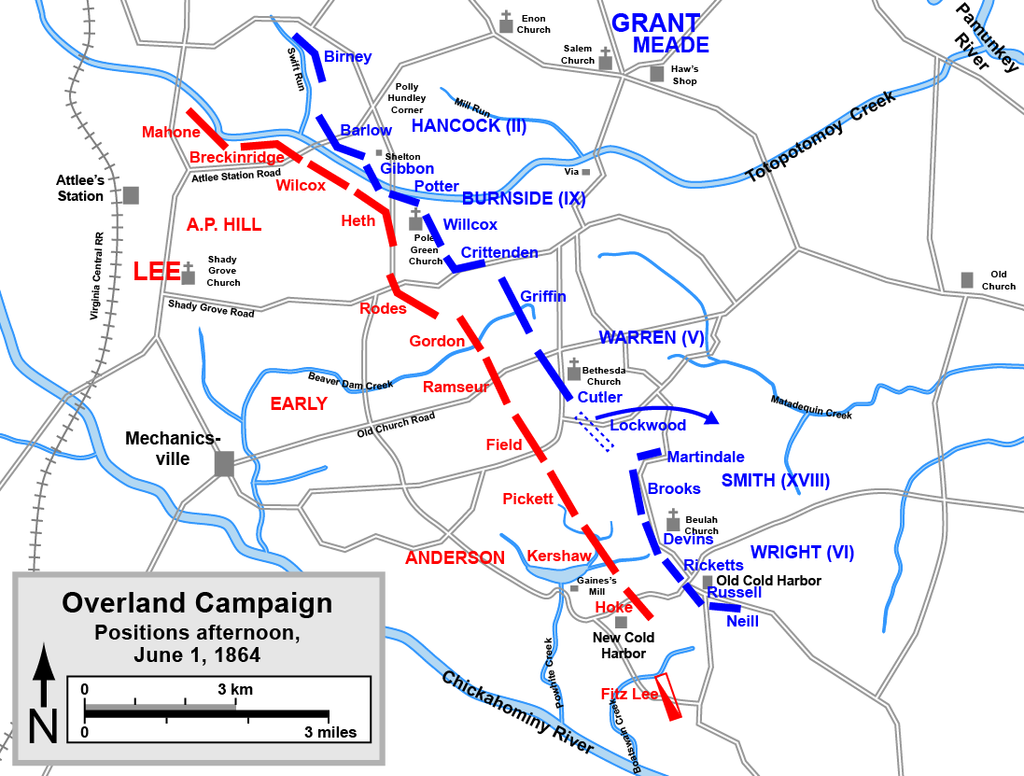
On the Union left, recently promoted Brigadier Emory Upton is driven back by Thomas Clingman, who then joins Eppa Hunton’s in stopping Colonel William Truax’s attempt at a breakthrough in the Gray line.
In the center, Warren’s Corps holds against Early’s troops despite General Henry Lockwood getting lost during the fighting. He is sacked while his Division is folded under Samuel Crawford.
The fighting on June 1 ends by nightfall, with serious casualties on both sides, but little territorial shifts.
Overnight, Meade and Grant agree to again focus their June 2 attack on their left, while also ordering Burnside and Warren to threated Lee on the far right. To add firepower, Hancock shifts his men south to Wright and Smith to create a strike force of 35,000. But the II Corps troops are worn out by the march and the July 2 attack is canceled.
Lee uses the pause to move Breckinridge’s Division, along with Wilcox and Mahone, down to counter the Union build-up. He knows this ground very well and sets up a defense marked by zig-zag trenches and deadly fields of fire.
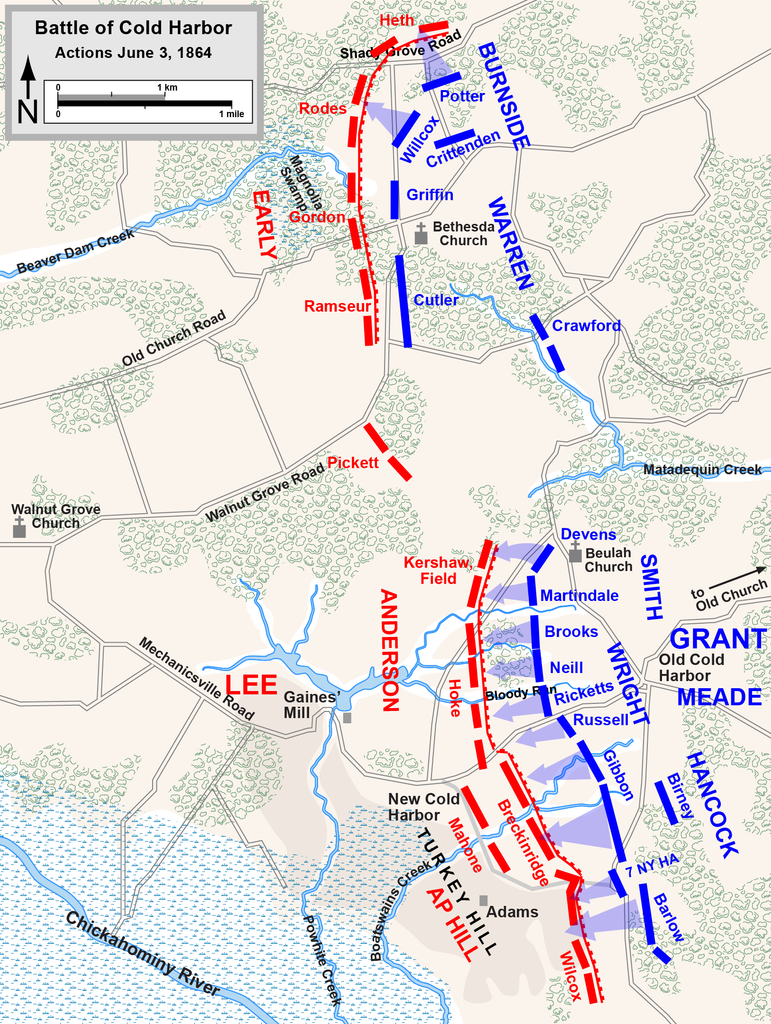
According to legend, on June 3 individual Blue soldiers pin their names on the back of their uniforms so their bodies can be identified after the 6:30am charge. A bloodbath follows with some 3,000-7,000 federal losses vs. only 1,500 for the rebels in the span of 30 minutes. It ends at 12:30pm when Grant acknowledges that he has lost.
After the war he expresses his regrets for the outcome:
I have always regretted that the last assault at Cold Harbor was ever made…
(with) no advantage whatever was gained to compensate for the heavy loss
we sustained. Indeed, the advantages…were on the Confederate side… This
charge seemed to revive their hopes temporarily
The two armies remain on the field from June 4 to June 12 with small skirmishes replacing large scale operations. Grant then sidles east along the Chickahominy River, bypassing Richmond and coming to rest on June 15 at City Point, ten miles northeast of Petersburg. Henceforth he will regard capturing Petersburg as the road to Richmond.
The size of Lee’s victory at Cold Harbor is reflected in the lop-sided casualty figures: 12,738 for the Blues and 5,287 for the Grays. This brings the total losses so far in the Overland Campaign to 55,000 for Grant and 33,000 for Lee. Still, the Union can far better withstand the attrition and all that the rebels can do militarily after Cold Harbor is attempt to defend their capital.
Northern anti-war critics call Grant a “butcher” for Cold Harbor and demand that negotiations begin for peace. Lincoln senses a growing public sentiment against the war in DC and fears that it might represent the South’s final escape path.