Section #1 - The American Civil War: 1861-65
Chapter 39: The Union Scores a Pivotal Win at the Battle of Gettysburg
As Lee works his way on a 21 day, 115 mile march up the Shenandoah Valley, he detaches Jeb Stuart’s Cavalry to track the movement of enemy troops heading north to meet him. But Stuart is forced to swing way east and loses all contact with Lee for eight days, June 25 to July 2.
On June 28, Lee reaches Chambersburg, Pennsylvania, 28 miles northwest of the town of Gettysburg, before dispatching his I and II Corps to Cashtown and his III Corps to Carlisle. If need be, he will re-unite them at Gettysburg along several of its ten crossroads.
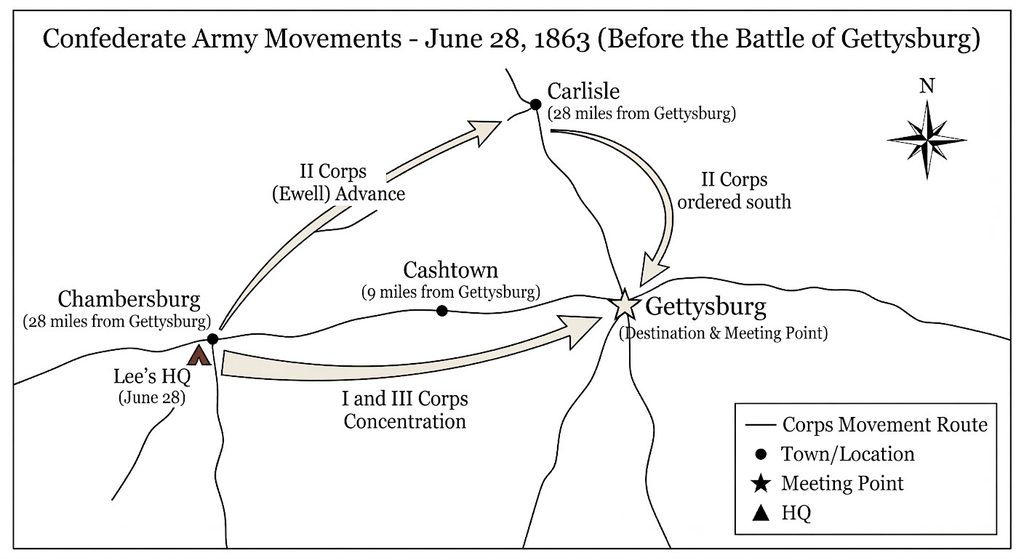
On that same day, Pennsylvania native, Major General George Meade, learns of his promotion to lead the Union troops after Lincoln accepts Joseph Hooker’s resignation. His roughly 94,000 engaged troops are divided across seven Corps plus Cavalry and Artillery under Henry Hunt.
| Corps | I | II | III | V | VI | XI | XII | Cavalry |
|---|---|---|---|---|---|---|---|---|
| Command | Reynolds | Hancock | Sickles | Sykes | Sedgwick | Howard | Slocum | Pleasanton |
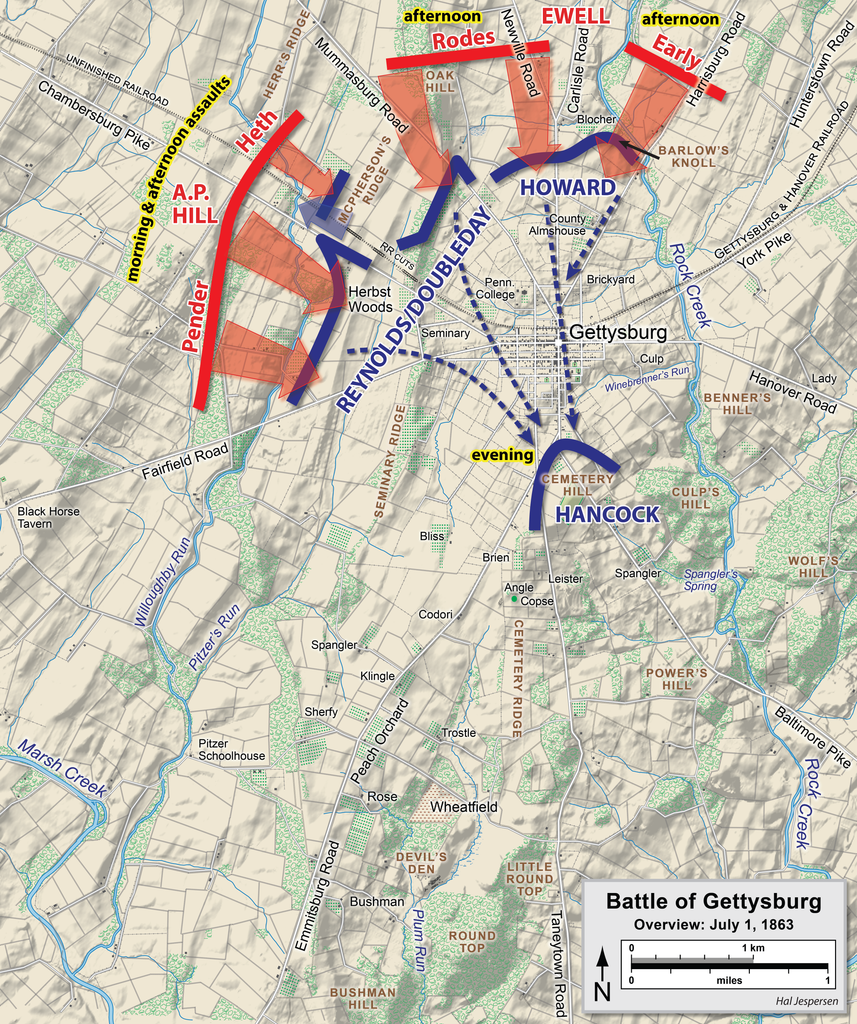
From Chambersburg the order goes out from Lee to avoid all engagements with Union troops until contact with Stuart is regained. But early on July 1, recently appointed Major General, Henry Heth, decides to send a small unit under James Pettigrew along the Chambersburg Pike into Gettysburg, ostensibly in search of shoes and other supplies. At 7:30am they are fired upon by Union dismounted cavalrymen under Generals John Buford and Thomas Devin, one mile northwest of Gettysburg along Marsh Creek. Thus begins the pivotal battle of the Civil War.
By 8:30am Buford is joined by Major General John Fulton Reynolds in command of his own Iron Brigade, along with the III and XI Corps. Both recognize that the high ground along Cemetery Ridge will be key to any stand-up battle, and agree to delay the Grey advance in that direction. Reynolds signals Meade who is 13 miles south at Taneytown, heads east to secure initial reinforcements, and returns by 10:00am – only to be struck in the neck by a minie ball just as he is arraying his troops. He will be the highest ranking officer to die in the fighting.
An uncertain Lee arrives around 2:30pm on Day One. With Longstreet not yet up, he is inclined toward caution until he spots Robert Rodes’ II Corps Division overrunning the Blues from the north, along the Carlisle Road. At that point Lee waves all of his troops forward.
This begins the race by both sides to gain control over Cemetery Ridge, first by capturing Culp’s Hill which overlooks it. Lee asks A.P. Hill to lead, but he is bed-ridden and declines. He then turns to General Ewell, ordering him at 4:45pm to take the Hill “if you find it practicable.” After two hours Lee’s hopes run out when Ewell reports that, despite Jubal Early reaching the hill’s crown, he called the advance off because General Edward Johnson’s Division did not arrive in time to sustain the move. (Many military historians cite this failure to capture Culp’s Hill on July 1 as the turning point in the entire battle.)
Map by Hal Jespersen, www.posix.com/CW
Meanwhile additional Union soldiers are arriving along the ridge to join the I/XI/XII Corps already present under O.O. Howard. The III/II Corps arrive by sundown when Hancock tells a reluctant Howard that Meade has placed him in overall command. By evening the number of Union Divisions present has grown from six to thirteen and Hancock hands out his his troop assignments. Meade arrives at 3:00am and agreement is reached to fight rather than flee.
Late at night, Lee confers with his three Corps commanders about plans for Day 2. He is certain that he wants the main strike to be led by Longstreet and aimed at Cemetery Ridge. But he goes back and forth with Ewell and Early about whether to try again for Culp’s Hill or swing their men around west to join Longstreet. When Ewell signals support for staying in place, Lee has his plan. A left hook delivered at Culp’s Hill tied to a straight blow against the Federal right.
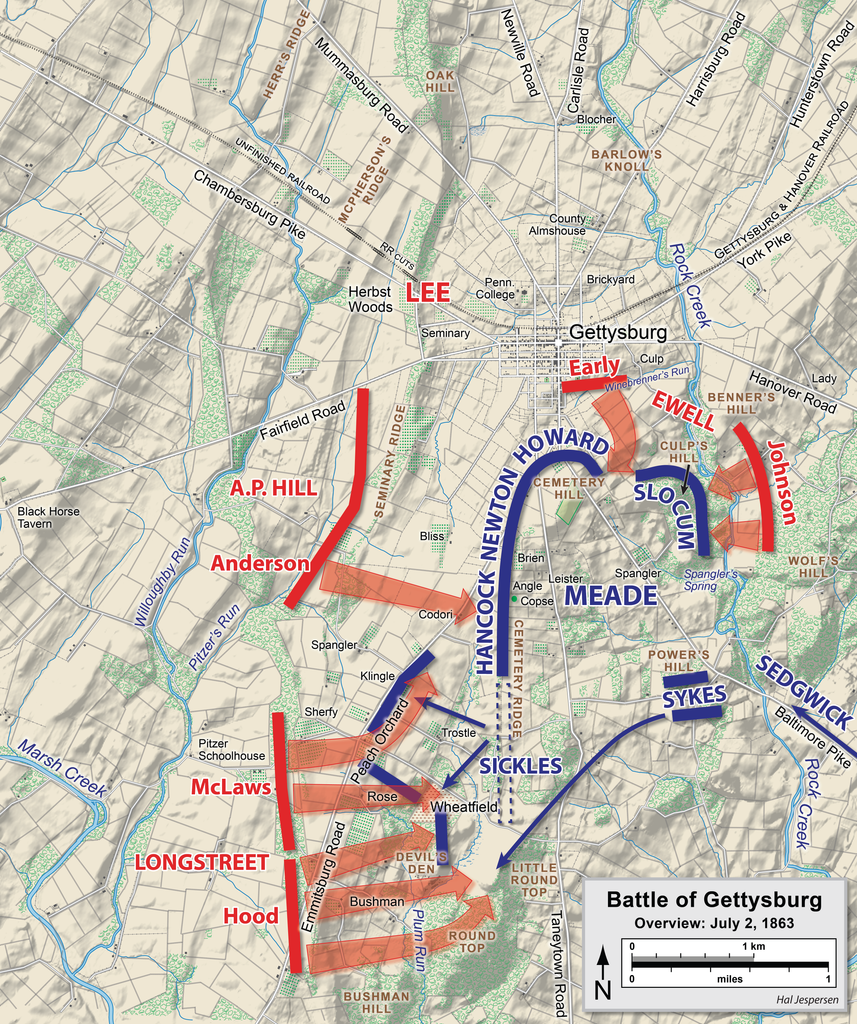
While wishing to carry out the coordinated assault early on July 2, Lee now meets his “Old Warhorse,” Longstreet, along Seminary Ridge to align the troops. But Longstreet shocks him by arguing that the army should be withdrawn to the east between Meade and Washington D.C., forcing a defensive victory mirroring Fredericksburg. After a heated disagreement, Lee orders Longstreet to attack diagonally and en echelon, up the Emmetsburg Pike. This despite a further protest against fighting with “one boot off” given that Pickett’s Division is not yet up.
Lee’s plan is complicated, and to accomplish it, Longstreet must secretly move his troops circuitously from Culp’s Hill south and east to the Pike. In practice this becomes a five hour delay marked by backtracking to prevent being spotted by Union observation posts on the two Round Top Mountains. Finally, at 4:00pm Longstreet arrives at 4:00pm at Lee’s assigned jumping off point on the Pike near Rose Woods.
But once there, he is stunned to find that General Sickles’ entire III Corps has come down from Cemetery Ridge, without consulting Meade, to assume a “better position,” and is facing him directly across the road. Both Hood and his Division General, Evander Law, tell “Old Pete” that the attack up Emmetsburg Pike is no longer feasible, since Sickles will crush their right flank.
While an obstinate Longstreet orders them to proceed with Lee’s plan, Law simply disobeys ad crashes across the Pike into Rose Woods heading toward a wild rocky outcropping known as the Devil’s Den. Hood follows until struck in the left arm by a shell that renders it useless for the rest of his life. The prize now is the plateau atop Little Round Top which, if captured, will allow the Confederates to point their artillery north and enfilade all of the Blue troops spread out for two miles along Cemetery Ridge.
Colonel William Oates and his 368 Alabama men make good progress up Little Round Top until nearing the peak, when met by a sudden barrage of gunfire. It comes initially from the V Corps’ 3rd Brigade under Col. Strong Vincent. They have been sent at the last second by chief engineer, General Gouvernor Kemble Warren, who spots the potentially fatal gap in the Union defenses. Warren also sends General Steven Weed’s brigade and two cannons under Charles Hazlett. They are still undermanned but dug in by the time Oates finds them.
A fierce clash for Little Round Top follows. During the fight, Vincent, Weed and Hazlett are all killed and the moment of greatest peril falls upon ex-Bowdoin College professor, Col. Joshua Chamberlain. As the 15th Alabama nears, Chamberlain leads his 385 men in a wild bayonet charged down the mountain that sends the rebels running and saves the plateau.
Around 5:30, Longstreet re-directs McLaws, ordering him to advance against Sickle’s salient in the Peach Orchard. Union General David Birney’s 1st Division receives the first rebel blow, with J.B. Kershaw’s South Carolinians and William Wofford’s and Paul Semmes Georgians heading through the Peach Orchard and toward a large Wheatfield in its rear, defended in part by the Frenchman, Col. Regis de Trobriand.
As Sickles rides along his defense line, his right leg is shattered by a shell, and he is carted off to a hospital where it is amputated. Shortly after, the rebel thrust into the Wheatfield is halted by re-deployed units of General Hancock’s II Corps under 1st Division General John Caldwell. The price to pay, however, includes the deaths of Col. Edward Cross and Generals Steven Weed and Samuel Zook.
William Barksdale’s brigade of Mississipians are next into the breech, claiming the Peach Orchard and nearly a thousand prisoners. The exuberant Barksdale then points his sword toward his next goal, Cemetery Ridge, before being shot in both legs and the chest. He dies in agony the next morning.
The residual component of the en echelon strategy begins around 6:20PM and features two of Hill’s Divisions under Generals Cadmus Willcox and Ambrose “Rans” Wright. They cross the Pike north of McLaws and head toward the crest of Cemetery Ridge.
Hancock spots the advance and recognizes that in moving Caldwell’s troops to support the Wheatfield defense, all that remains in the way of the oncoming grey brigades is A.A. Humphrey’s thin command. The moment is saved only by the appearance of the 1st Minnesota brigade, 262 men under Col. William Colville.
They hold for ten minutes despite Colville being killed and 215 others either dead or wounded. In that interim, members of General John Gibbon’s Division arrive on the scene.
Wilcox actually reaches the top of Cemetery Ridge, but his call for reinforcements is unmet – in part due to command confusion between Longstreet and Hill. The result is that Longstreet’s Tige Anderson stays put, while Hill’s William Mahone insists that his orders were not to engage.
Added disarray traces to a leg wound suffered by General William Pender, which requires amputation and leads to his death two weeks later from post-surgery infection. His successor, James Lane, observes the fight on the Ridge without clear orders, and, like Mahone, decides to abstain.
This leaves the unaccompanied Wilcox and Wright with no choice but to retreat.
Map by Hal Jespersen, www.posix.com/CW, CC BY 3.0 https://creativecommons.org/licenses/by/3.0, via Wikimedia Commons
By around 7:00 PM the Day 2 battles on the rebel right are over. Longstreet later says: “I do not hesitate to pronounce this the best three hours of fighting ever done by any troops on any battlefield.”
Some 22,000 Confederates have tried to conquer 40,000 Union troops while losing 7,000 men. What began as a rigid plan delivered to Longstreet by Lee breaks down when Sickles appears along Emmetsburg Pike. Communication failures and fatalities contribute to the setback.
All that remains then on Day Two is Ewell’s evening attack on Culp’s Hill.
Ewell has spent most of the day upset over Lee’s comment the prior evening about the failure “to pursue our advantage” by attacking Culp’s Hill. He is determined to atone for the implied criticism.
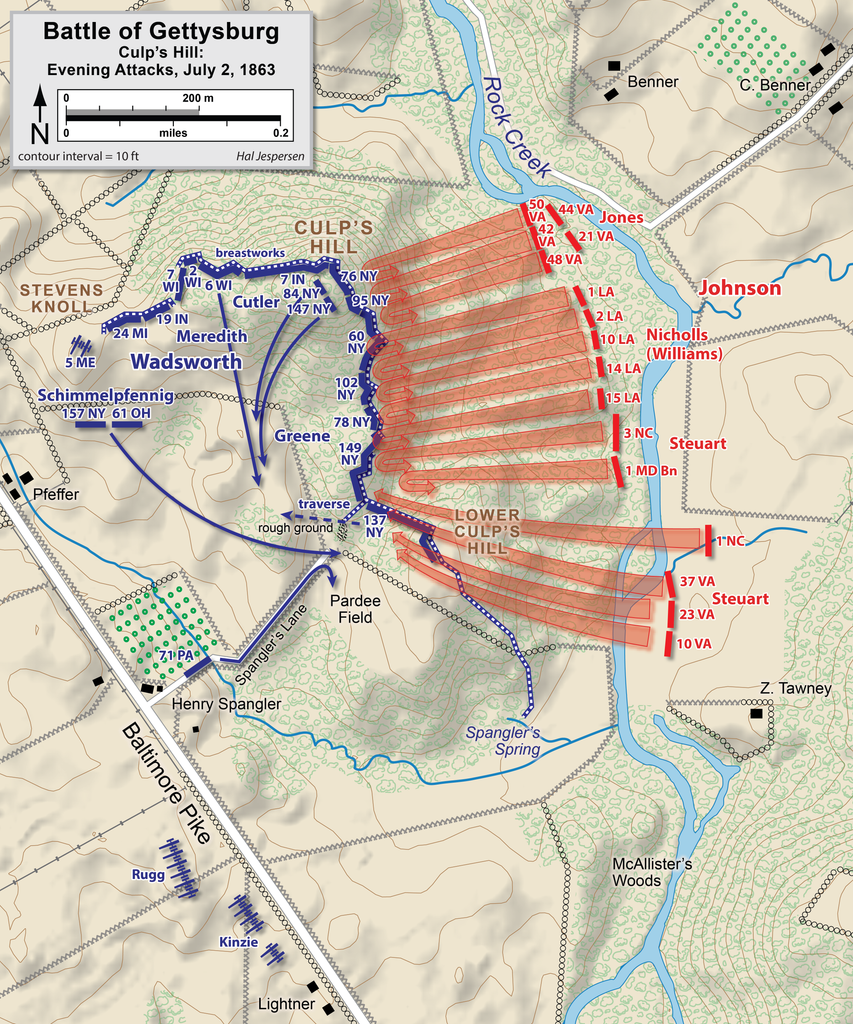
By 6:00 PM his forces encircle the barb of the Union’s fishhook defense, with Edward Johnson’s Division on the far left and Early’s Division on his right. He sees his mission as holding the Union in place while Longstreet delivers the main blow tomorrow. That is, unless he finds a chance to take the Hill and plow down into the Union center on Cemetery Ridge.
With no apparent threat on his right throughout the day, Meade has felt secure enough to shift John Newton’s VI Corps Division and most of Slocum’s XII Corps to defend against the tail end of Longstreet’s actions to the south. This means, however, that Ewell now outnumbers the defenders on Culp’s Hill, composed mainly of the remnants of Howard’s routed XI Corps and survivors of the decimated Iron Brigade.
Map by Hal Jespersen, www.posix.com/CW, CC BY 3.0 https://creativecommons.org/licenses/by/3.0, via Wikimedia Commons
Ewell opens with an artillery barrage around 7:00PM by Major Joseph Latimer from nearby Benner’s Hill. General Johnson then unleashes his four brigades roughly a half hour before sunset.
His right flank, led by General Harry Hays, actually reaches the crest of the Hill until it is halted at the last second by a brigade under Samuel S. Carroll sent by Hancock. Meanwhile, on the far left, George Steuart’s men are met by 61 year old General George “Pap” Greene’s XII Corp troops, deeply dug in and able to hold their own.
The fighting lasts for almost two hours before sputtering out around 9:00PM.
With that, Day Two is over at last.
The Confederates have lost another 9,000 men in total to go along with the 8,000 on Day One. The Union also loses 9,000 for the second day in a row.
As July 3 approaches, Lee is buoyed by several factors: Stuart’s Cavalry and Pickett’s Division have arrived; Harry Hay’s men were able to reach the peak of Culp’s Hill; McLaw’s has taken the Peach Orchard; and “Ran’s” Wright has made it all the way to Cemetery Ridge before retiring.
By midnight he has settled independently on his Day Three strategy, ordering Ewell to attack the fishhook area at dawn and Longstreet and Hill to simultaneously hit the Union Center. Meanwhile, Meade convenes a conclave at 11:00 PM with all seven of his Corps commanders present who vote to stay and defend their position on the Ridge.
At 4:30am a Union barrage at Culp’s Hill ends Lee’s hope for a concurrent movement. Ewell will fight for seven straight hours before finally pulling back.
Lee arrives on the Confederate right around 9:00AM, placing Longstreet in overall command of his own Division and two belonging to A.P. Hill.
Lee, however, is greeted with unmasked acrimony. After telling Longstreet that “the enemy is there and I am going to strike him there,” Old Peter responds:
I have been a soldier all my life and my opinion is that no
15000 men ever arrayed for battle can take that position.
The attack begins at 1:07pm with a bombardment of the Union center by 63 cannon from the left and another 88 from Col. Porter Alexander on the right. Once completed the troops will step out from the woods along Seminary Ridge and begin a 1/2 mile advance to the Emmetsburg Pike where they will need to clear rail fences blocking their way. Then their final challenge will be another 1/4th mile climb up a modest incline to reach the enemy.
Their aiming point is a small “copse of trees” set in an “angle” between two stone fences manned by the Union forces.
Surprisingly the attack starts out with 11,000 Confederate troops up against only 5,700 defenders, after Meade shifts Slocum’s XII Corps toward Culp’s Hill fearing that Lee may come at him from that direction.
General Hancock is thus stuck in the center with only 6 brigades spread across 1/2 mile under three men: on his right, Alexander Hays, known as “Old Eleck,” who will later be killed at the Wilderness; in the center, John Gibbon who will accompany Grant all the way to Appomattox; and on the left, Abner Doubleday, already in pain from a neck wound received in his Day One defense of McPherson’s Ridge alongside Buford.
The Union disadvantage in manpower is also matched when it comes to artillery support. Of its 360 cannon at Gettysburg, only 101 are positioned to cover the ground where the rebels will advance.
The stage is now set for a Confederate barrage that lasts for roughly an hour, but with only 200 Federal casualties as the bluecoats huddle behind their brick fences or on the downslope of Cemetery Ridge. The level of smoke generated hampers the ability to aim, and most of the shells go over the soldiers’ heads, landing in the rear on wagons, canteens and other supplies, in addition to Meade’s headquarters which he exits.
Meanwhile, the wily Union Artillery Commander, General Henry Hunt, decides to hold much of his firepower in reserve for the troop assault to come. He orders John Hazzard’s 29 guns on the Union right and Freeman McGilvery’s 37 on the left to remain silent. This lasts until Hancock – who rides up and down the lines during the inferno to instill courage – approaches Hunt insisting that troop morale requires a response. He agrees and orders volleys from T.W. Osborne’s 29 guns in the center and the six batteries on Little Round Top.
As the grey barrage slows, Hunt silences all his guns around 2:45 PM hoping the Confederates conclude that their opponents have been sufficiently softened to begin their troop assault.
But regardless, the urgency for the rebels to strike has already reached a crisis point – with the burden to decide the timing on the shoulders of artilleryman Porter Alexander. He is 28 years old at the moment and has been delegated by a disgruntled Longstreet to signal Pickett when to advance.
By 3:00 PM, Alexander is frantic, as his supply of shells is running out. He finally tells Pickett, “If you are to come at all, you must come at once!”
For Pickett, last in his class at West Point and having missed prior victories since a wound at Gaines Mill, the call is music to his ears. At last, his chance for glory. He turns in the saddle and waves his brigade forward with the cry: “Up to your posts and don’t forget today that you are from old Virginia.”
What follows is reminiscent of the British charge of the six hundred at Balaklava during the Crimean War. The Gray ranks step out from the trees around 3:00 PM in orderly fashion and begin their half mile march toward the Emmetsburg Pike.
In Pickett’s Division, Lewis Armistead places his hat on the tip of his sword as he goes to confront his dear friend Hancock. To his right, Richard Garnett, feverish and suffering from a wounded knee, sets out to redeem a tarnished reputation. Finally, comes a non-West Pointer, James Kemper, formerly Speaker of the Virginia House of Delegates.
J. J. Pettigrew, like Kemper, lacks formal military training and has served in politics. His early reputation is as a scholar, with fluency in Latin and Greek and the top grades in his class at North Carolina College.
Once underway, Pettigrew’s men, along with Isaac Trimble’s small unit, have further to go to reach the Pike — which forces Pickett to execute an early “left oblique” prior to reaching the Pike to dress the lines and achieve proper alignment.
But before the men can even arrive at the rail fences they are already being shredded by canister fire, shells packed with metal pellets and nails which convert the Union cannons into deadly short-range shotguns.
The effects on Pettigrew’s left are immediately devastating, as four of his sixteen regiments break apart and flee for safety. Seeing this from afar, Longstreet senses that the rout he expected is on. He weighs the wisdom of sending reinforcements to Pettigrew before holding them in case of a counter attack by Meade.
As the Confederates approach the Ridge, additional bluecoats are filtering in to support Hancock’s center, while two units move to protect his flanks.
On the Union right, it is Alexander Hays who advances his 8th Ohio regiment with 450 men and 2 brass Napoleon cannons to provide the enfilading fire that essentially destroys Pettigrew’s remaining troops. General Trimble’s left leg is shattered and will require amputation.
On Hancock’s left it is George Stannard whose two Vermont regiments similarly punish Pickett’s brigades. As Hancock rides over to congratulate Stannard, a minie ball strikes his saddle driving a nail into his thigh, a wound that will plague him the rest of his life. Still he remains in place after dismissing the stretcher bearers.
Almost miraculously, parts of Pickett’s three brigades manage to reach the Union lines.
Garrett comes within 25 paces before being killed by a shot to the head. Kemper receives a wound in the left groin near the femoral artery, but survives after being carried back to safety. Armistead actually breeches the Union line where he is struck three times in the chest and once in the arm. When he falls he groans “is there no help for the son of a widow?” – a Masonic plea that brings temporary aid before he dies in a Union field hospital two days later. Hancock mourns his death.
The few soldiers who make it to the Copse of Trees engage in fierce hand to hand combat. Twice wounded Medal of Honor winner Alexander Webb and his four Pennsylvania regiments refuse to budge, alongside Colonel Norman Hall and William Harrow. Within minutes the interlopers are driven back for want of numbers. Their achievement, however, will become known as “the high water mark of the Confederacy” – the last feasible chance for the South to win the war.
Pickett survives the onslaught, physically untouched but emotionally broken. From then on he will refer to Lee as “that old man who destroyed my division.”
Pettigrew’s horse is shot out from under him and his right hand is crushed by grapeshot, but he escapes the field only to die eleven days later in a rearguard action.
The final charge has lasted roughly a half hour, with the Confederate retreating around 3:30PM. As they go, the jubilant Federal taunt them with cries of “Fredericksburg,” signaling payback for their own defeat there in 1862.
Of the 11,000 rebels who head up the hill, only 6,000 make it back down, while the Union counts only 1,500 casualties.
Lee is visibly shaken by the loss and rides his white horse Traveler onto the field under fire to praise his men, telling them “the blame is all mine,” and calling for them to rally back on Seminary Ridge in case the Union launches a counter attack.
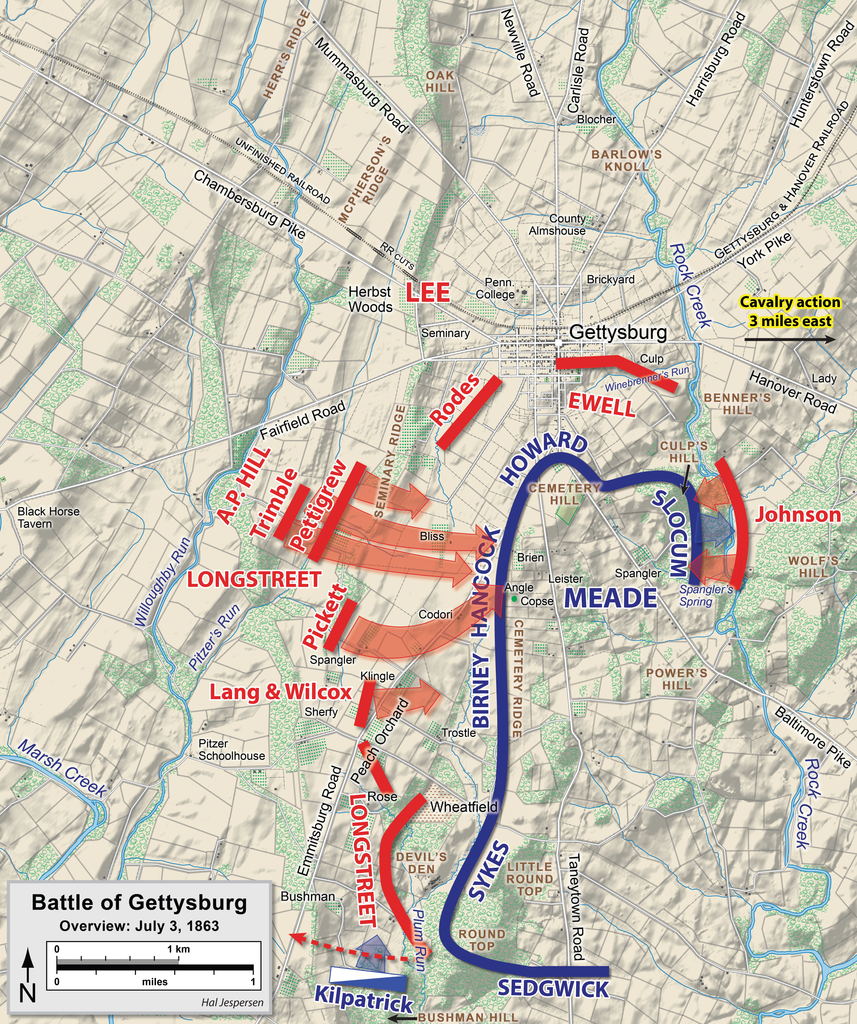
Map by Hal Jespersen, www.posix.com/CW
As the Confederate are turned back, a cavalry battle to the east finds Jeb Stuart’s horsemen defeated by George Custer’s Michigan Wolverines.
On July 4, Independence Day, the two armies remain on the field amidst an unending downpour. Lee hopes that Meade will come down from Cemetery Ridge to attack him, while the “Old Snapping Turtle” is far too wise to fall for the trap.
In an emotional moment, Lee will tell Longstreet: “It’s all my fault. I thought my men were invincible.”
Casualties at Gettysburg are horrifying: 32,043 for the Union; around 30,000 for the Grays. Included here are 11 General Officers who lose their lives:
| Union | Confederate |
|---|---|
| Reynolds | Semmes |
| Zook | Barksdale |
| Weed | Armistead |
| Farnsworth | Garnett |
| Vincent | Pender |
| Pettigrew (during retreat) |
Late on July 4, Lee’s army begins its retreat, after an invasion that lasts about a week in enemy territory. Washington encourages Meade to pursue and destroy Lee’s army and a series of rearguard skirmishes continue until July 18 when all of the rebels have crossed the Potomac.
In August a downcast General Lee asks President Davis to replace him as head of the army, a proposal that is immediately rejected. Despite criticism for allowing Lee to escape, Lincoln retains Meade, although under close supervision by Grant.