Section #1 - The American Civil War: 1861-65
Chapter 36: The Month of May Belongs to Grant
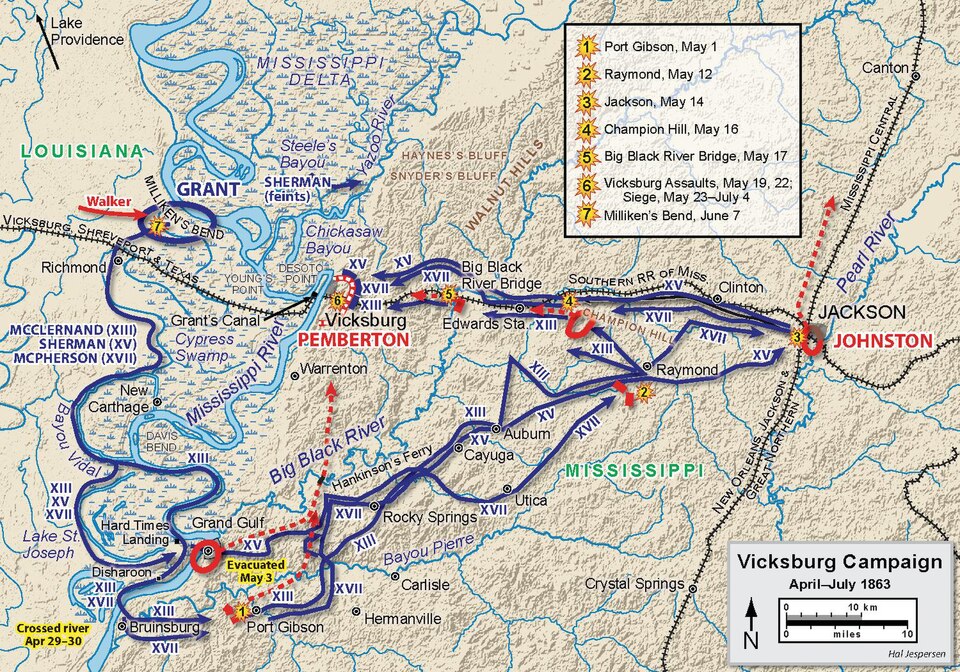
Once the Union army is onto Mississippi soil, Grant is relentless in his quest to take Vicksburg.
Hlj, CC BY-SA 4.0 https://creativecommons.org/licenses/by-sa/4.0, via Wikimedia Commons
The initial resistance comes on May 1, 1863 near Port Gibson, where Union brigades under Pea Ridge hero, General Eugene Carr, and Edwin Hovey are met north of Magnolia Church by Gray troops under Generals John Bowen and Edgar Tracy. But they are outnumbers by 3:1 and after holding on throughout the day, finally retreat around 5;30pm. Tracy is killed in the action while Bowen is promoted to Major General for his tenacious stand.
The outcome at Port Gibson causes Grant to alter his original plan to head directly north along the Big Black River and then east against Vicksburg. His concern it that would leave a sizable number of Confederate troops in his rear only 45 miles away at the capital of Jackson. So he sets his sights on first reducing Jackson.
In the lead is Major General James McPherson and the 11,000 men of his XVII Corps who arrive along the Utica Road at the town of Raymond on May 12. They are met early morning by a brigade of 3,000 under General John Gregg who initially push McPherson backwards. This changes, however, after Blue reinforcements under Generals John Logan and John Stevenson, enter the fray along with a new 22 cannon battery. By 4:00pm Gregg realizes that he is about to be overrun and begins his retreat across Fourteenmile Creek and northeast through Raymond on their way to Jackson.
Next comes a surprise after Joseph Johnston, the fourth ranking officer in the Confederate Army, takes command at Jackson despite telling Jefferson Davis that he should support Bragg in Tennessee rather than Pemberton at Vicksburg. Still Davis insists and Johnston arrives at Jackson on May 13, one day after the loss at Raymond. While word of the possible arrival of brigades under States Right Gist and Samuel Maxey that would boost his total force to nearly 15,000, Johnston sends Davis a spiteful wire saying “I am too late!” Starting at 3:30am on May 14 he abandons the capital, hoping to transport the 6,000 Gray troops back to Vicksburg.
Sherman does not leave Jackson but instead burn it to the ground, including its armament factories and train tracks. This accelerated form of retribution is a precursor to what the General later labels as “total war” during his march through Georgia.
Two days after Jackson falls, the turning point battle in the fight for Vicksburg comes 25 miles east at Champion’s Hill.
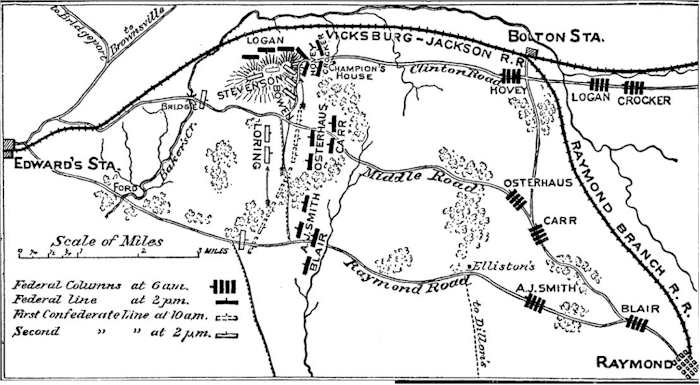
As Johnston departs for Vicksburg, he orders Pemberton to come forward from Edward’s Station to attack Grant along the Clinton Road. The Gray troops, some 23,000 strong, set up a three mile long defensive perimeter anchored by Champion’s Hill on their left.
The hill is akin to a cliff, at its high point rising 100 feet above the surrounding approaches. Major General Carter Stevenson is chosen to defend it. The center belongs to John Bowen, just north of the Billyfield/Middle Road. The right falls to the cantankerous William Loring, called “Wings” for the loss of his arm during the Mexican War.
Jim Drake, Public domain, via Wikimedia Commons
Skirmishing runs from 7:00 to 10:00am when Grant arrives. He has 35,000 troops between McClernand’s XIII Corps and McPherson’s XVII Corps with Sherman’s XV in reserve.
Union Order of Battle at Champion’s Hill
| Corps | Commander | Divisions |
|---|---|---|
| XIII | McClernand | 9 Osterhaus, 10 A.J. Smith, 12 Hovey, 14 Carr |
| XV | Sherman | 2 F.P. Blair Jr. |
| XVII | McPherson | 3 Logan, 7 Crocker |
The fight for Champion’s Hill itself dominates the action. The first assault finds Alvin Hovey’s 9th Division and John Logan’s 3rd gaining the plateau by 1:00, after more than an hour of fierce hand to hand combat. Then a heroic counter attack by John Bowen retakes the hill around 1:30pm. To stabilize his gain, Pemberton orders Loring to send support, but he refuses saying he cannot spare any men.
McPherson has no such hesitation and his 7th Division under Marcellus Crocker hands the momentum back to the Blues by late afternoon. Pemberton realizes that the numbers are simply against him and decides to retreat.
This becomes another challenge since the Jackson Road is already controlled by the Federals. The only hope becomes backing down to Baker’s Creek and connecting with the Raymond Rd. back to Edward’s Station where he began the day.
With the Union closing fast, holding the ford over the Creek falls upon Loring’s 1st Brigade commanders, Lloyd Tilghman. He succeeds in buying needed time before a 3’’ Parrott shell explodes in his front throwing a fragment that disembowels and kills him instantly.
The remaining Gray soldiers under Loring follow a different escape path, moving further south across the Big Black River Bridge held by Bowen’s men.
But by midnight on May 14, the Federals are at Edward’s Station and the turning point battle of Champion’s Hill is over. The road to Vicksburg is now open to Ulysses Grant.
He criticizes McClernand for allowing the rebels to get away, and chases after them to the outskirts of the city. After frontal strikes on May 19 and 22 fail to break Pemberton’s formidable defensive front, Grant decides to initiate a siege beginning on May 25.
Grant’s Campaign Against Vicksburg
| Date | Events |
|---|---|
| December 5, 1862 | CSA raid at Holly Springs |
| December 29 | Sherman stopped at Chickasaw Bayou |
| April 16, 1863 | Porter crosses past Vicksburg guns |
| April 30 | Grant crosses the Mississippi to Bruinsburg |
| May 1 | Victory at Port Gibson and change of plans |
| May 12 | Union win at Raymond |
| May 14 | Johnston abandons Jackson |
| May 16 | Turning point triumph at Champion Hill |
| May 17 | CSA retreat at Baker’s Creek & Big Bear Lake |
| May 19-22 | Two frontal assaults fail |
| May 25 | Start of siege |