Section #1 - The American Civil War: 1861-65
Chapter 10: The Battle of 1st Manassas Signals the Fury to Come
With enlistment time running out on his three-month recruits, Lincoln orders Irwin McDowell, his first leader of the Army of the Potomac, to begin an overland campaign to capture Richmond. On July 16, 1861, McDowell leads his rag-tag band of 36,000 troops west for 30 miles along the Warrenton Pike toward Manassas Junction. At daybreak on July 21 his men are arrayed west of the Junction where some 33,000 Confederates have set up a defensive camps under General Beauregard and Joseph Johnston.
The battle begins at 5:15am with the Union driving Beauregard’s rebels south of the Junction toward Henry Hill. Once there, however, they are stopped cold around 3:00pm by Virginians under Generals Bee and Jackson. The former is mortally wounded while the latter earns his lasting sobriquet: “there stands Jackson like a stone wall.”
When Confederate reinforcements under General Johnston arrive by 4:00pm, the rout is on for McDowell, whose troops panic and flee the field, with most racing back toward Washington.
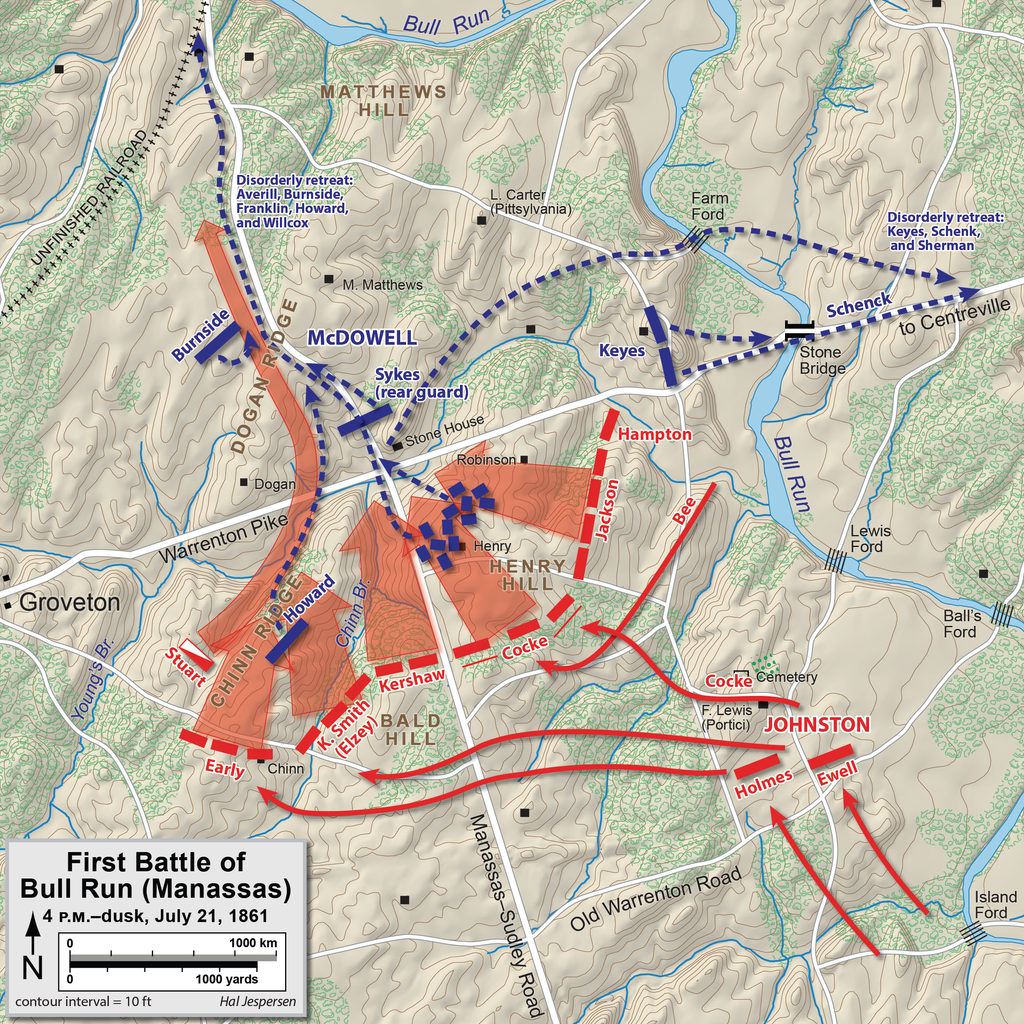
Hlj, CC BY-SA 4.0 https://creativecommons.org/licenses/by-sa/4.0, via Wikimedia Commons
Casualties for the day come to 1,982 Confederates with 387 KIA vs. 2,708 Union with 481 killed. But the impact of the loss in the North extends far beyond the body count. The notions of a short war and an easy victory die at Manassas. On July 22, President Lincoln calls for 500,000 troops to enlist for three years duty. On July 25, 1861 he sacks McDowell and names George McClellan as General-in-Chief of the Union Army.