Section #1 - The American Civil War: 1861-65
Chapter 71: Hood Absorbs His Final Defeat at Nashville
On December 2, 1864, what remains of Hood’s army reaches Nashville, where George Thomas waits with an elaborate 7 mile defense line anchored by the Cumberland River in the rear and multiple forts facing the invaders.
Instead of another headlong attack, Hood takes a defensive posture, hoping that Thomas will come out and attack him. At first, Thomas refuses to budge, but is then ordered to act in harsh messages from Washington.
On December 15, he sends two black brigades under Major General James Steedman for a diversionary assault on the Confederate right, while simultaneously aiming Schofield’s main infantry and cavalryman James Wilson at their left.
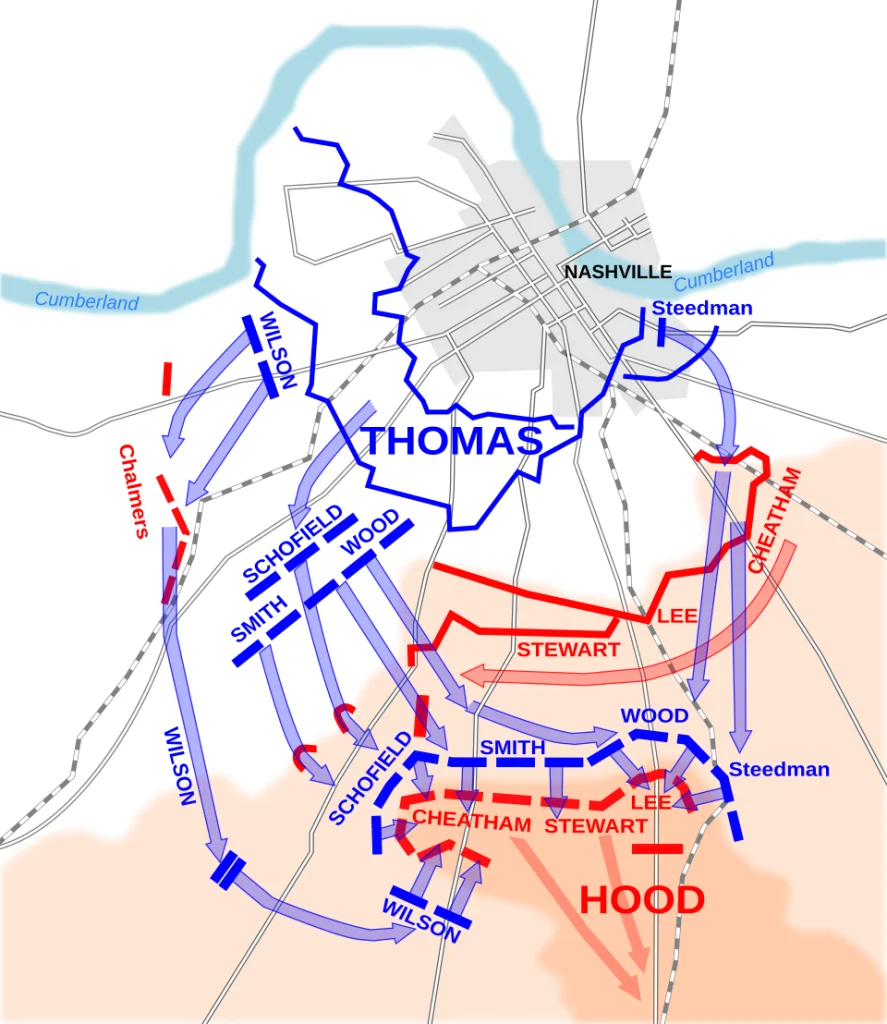
Wikimedia Commons, public domain
While both flank attacks succeeded in eroding the rebel position, Hood draws back that evening into a more defensible posture.
On December 16, Thomas repeats his flanking tactic, but is stopped until Scottish General John McArthur’s three brigades overrun Shy’s Hill and roll up the Gray line west to east.
Hood has no other choice than to retreat and during the night of December 16 he flees south, with Thomas chasing until giving up on December 30.
Casualties for the battle are 3,000 for the North and 6,000 for the South.
But the loss at Nashville ends the existence of the Confederate Army of Tennessee. Hood began his move north with 38,000 men and, according to estimates, has roughly 15,000 left when it is over. He rides with them to Tupolo, Mississippi, before resigning on January 13, 1865.
An early hero of the South, Hood sacrifices his right leg and left arm to the cause. But he lives on until 1849, becoming a cotton broker and insurance executive, marrying and fathering 11 children and writing his wartime memoir. His death at age 49 is attributed to yellow fever.