Section #1 - The American Civil War: 1861-65
Chapter 28: The Union Move South Fails This Time at Fredericksburg
A reluctant Major General Ambrose Burnside replaces McClellan on November 7, 1862 and is immediately encouraged by Lincoln to make another overland movement toward Richmond. He enjoys a massive 122,000 man army and proposes a faint at Culpeper Court House masking a surprise crossing of the Rappahannock River on pontoon bridges to attack the city of Fredericksburg, Virginia.
The plan is a bust from beginning to end.
On December 9, the Union troops gathers west of the river in three “Grand Divisions:” the Right (II/IX Corps) under Edwin Sumner; Joseph Hooker’s Center (III/V); the Left (I/VI) behind William Franklin. They face Lee’s 78,500 men split between Jackson’s I Corp to the north and Longstreet’s II Corps to the south.
Marye’s Heights — Lee, Longstreet I Corps ← 900 yards uphill → Sumner II/IX Corps, Hooker III/V Corps — Town of Fredericksburg, Rap River
3 miles
Prospect Hill — Jackson II Corps ← 450 yards uphill → Franklin I/VI Corps — Rap River
But instead of the immediate surprise attack, the pontoon bridges needed to cross the 150 yard span of the Rappahannock have not yet arrived. This allows the Grey sharpshooters in town to pick off Burnside’s men throughout the 10th. On December 11, the bridges finally appear and the engineers begin to install them.
The Union crossings begin in the south, the Left Grand Division under Franklin making an easy move on the afternoon and evening of December 11. The clash there begins on the morning of December 13 with Franklin receiving a puzzling order from Burnside to send only two of his six Divisions forward — the Third under George Meade and the Second under John Gibbon – while keeping the other four in reserve. The battles around Prospect Hill and the Slaughter Pen are fierce, but by sunset the rebels have withdrawn to the west. Casualties in this arena are 5,000 (40% of Union total) for Franklin, and 3,500 (65% of CSA total) for Jackson.
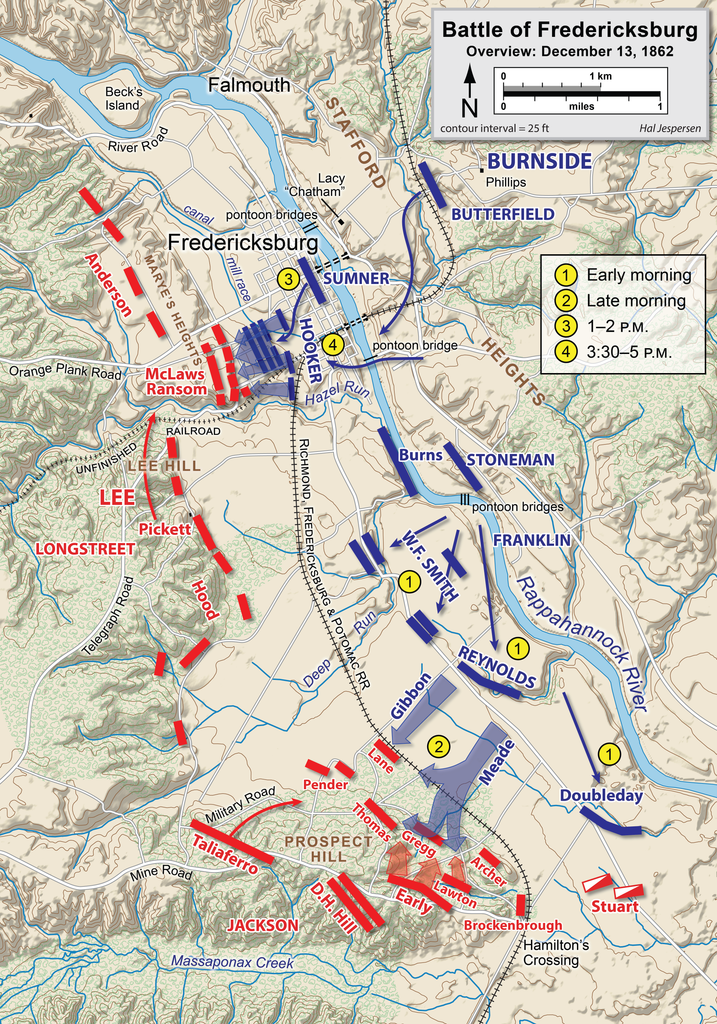
Map by Hal Jespersen, www.posix.com/CW, CC BY 3.0 https://creativecommons.org/licenses/by/3.0, via Wikimedia Commons
However, the most memorable and controversial action of the day involves Burnside’s assault on the ridges west of Fredericksburg involving his Right and Center Divisions. Both face great resistance crossing the river, but Sumner’s troops make it on December 12 followed by Hooker on the 13th. At that point, the conventional fighting begins.
Starting at 10:00am, the Union faces a 900 yard uphill climb from the town to the Confederates waiting behind an unassailable four foot high stone wall at Marye’s Heights. During the day, Burnside’s troops will make 14 separate unsuccessful attacks involving seven Divisions while suffering 6,000 to 8,000 casualties. The carnage prompts Lee, watching the waste of brave men from the ridge, to tell Longstreet, “It is well that war is so terrible, otherwise we should grow too fond of it.”
Four Generals are killed at Fredericksburg: George Bayard and Conrad Jackson for the Union and Maxcy Gregg and T.R.R. Cobb for the rebels. On January 26, 1863, Lincoln replaces Burnside with Joseph Hooker as the third commander of the Army of the Potomac.