Section #1 - The American Civil War: 1861-65
Chapter 47: Grant Takes Chattanooga
Bragg remains determined to destroy Rosecrans at Chattanooga, with the Union surrounded to the south by Confederates on Lookout Mountain and Missionary Ridge, and to the north by the Tennessee River and rebels guarding the crossing points.
A siege of the city begins in late September with food shortages impacting Rosecrans’s 40,000 troops and the city’s 2,500 residents.
Seeing the threat, Lincoln calls on Ulysses Grant to move east and take charge of the situation. He arrives on October 19 and two days later sacks Rosecrans and replaces him with George Thomas as Commander of the Army of the Cumberland.
A supply line breakthrough follows on October 27 when Thomas ferries troops across the Tennessee River at Brown’s Ferry. His landing is opposed by Colonel William C. Oates, resulting in the night battle of Wauhatchie. Thomas prevails and opens a supply route to Chattanooga known as the Cracker Line.
Grant now goes to work on a strategy to dislodge Bragg’s 44,000 man army from Lookout Mountain (elevation 1800 ft.) and Missionary Ridge (500 ft.). He does this knowing from battles like Fredericksburg and Gettysburg that sending infantrymen against an entrenched enemy on high ground has so far been doomed to failure.
A plan takes shape after Sherman arrives with 20,000 reinforcements in mid-November. It calls for dislodging Bragg by having Hooker attack his left flank at Lookout Mountain, while Sherman and Thomas launch coordinated thrusts against Missionary Ridge.
By this time it’s clear to both sides that Lookout Mountain is vulnerable. Union artillery at Mocassin Point strike its summit, while Confederate cannons there cannot be depressed enough to hit troops ascending along many paths to the top. Bragg acknowledges this on November 23, reducing Major General Carter Stevenson’s troop count to just under 9,000.
Hooker launches his XII Corps offensive on November 24, ordering John Geary’s 2nd Division to attack the valley at the base of the mountain with 10,000 men. Given the heavy fog and low hanging mist, this is recorded as “the battle above the clouds.” By dusk on the 24th Hooker tells Grant that the day went well; he is holding in the valley; and expects CSA to evacuate the crest.
November 24 also finds Grant ordering Thomas to conduct a “reconnaissance in force” of the rebel center along Missionary Ridge. He hopes to do so without prompting Bragg into a general retreat.
The loss of Lookout Mountain and the threat on his center cause a nervous Bragg to hold a meeting at 2:00am on the 25th to seek advice from his commanders. All agree to abandon Lookout Mountain, while Hardee joins Bragg in recommending a general retreat. But they are talked out of this by General Breckinridge who votes to stay and fight on.
Order of Battle at Chattanooga on November 25, 1863
| Command / Corps | Divisions |
|---|---|
| Confederates | |
| Breckinridge | Cleburne, A.P. Stewart, Bate, Stevenson |
| Hardee | Cheatham, P. Anderson, B. Johnson, Gist |
| Wheeler | 4 cavalry units |
| Union | |
| Granger (IV) | Cruft, Sheridan, Wood |
| Palmer (XIV) | R. Johnson, Davis, Baird |
| Brannan (Res) | Barnett, Church |
The battle resumes with Sherman leading off on the Union left with 16,000 men. However, instead of his usual competence, a series of piecemeal thrusts fail to oust Cleburne’s Division around Tunnel Hill.
Noting that Sherman is stalled, Grant sends Thomas’s Divisions forward around 4:00pm with orders to occupy the valley and rifle pits below Missionary Ridge.
The rebels are quickly overcome with survivors climbing up the face of the Ridge to save their lives. But then, instead of holding in place, the Union brigades join in the ascent. Around 5:00pm, two brigades in Wood’s Division — August Willich and William Hazen – make the first breakthrough at Birds Nest Road. Once there they begin flanking fire into both ends of the Confederate defenders and the rout is on.
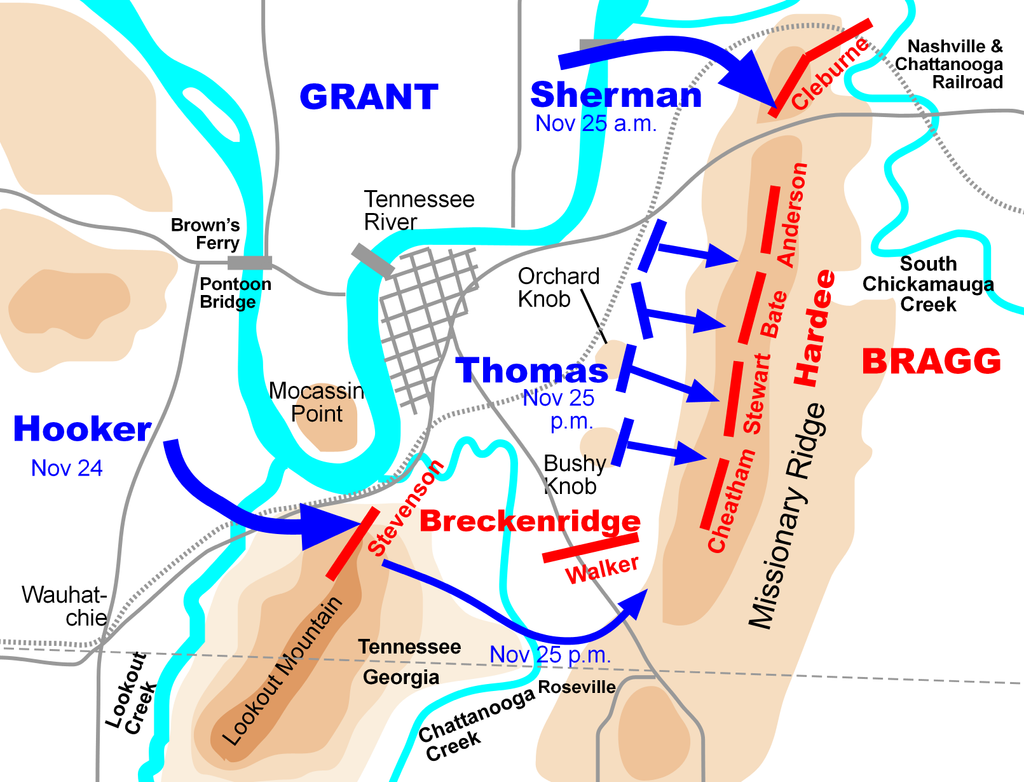
Map by Hal Jespersen, www.posix.com/CW. Public domain (released by the author).
A panicked retreat follows with Bragg’s army heading south toward Chickamauga Creek, trailed by Cleburne’s Division in case of Union pursuit.
Casualties amount to 5,824 for the Union and 6,667 for the Confederates, although Grant claims to have captured another 6,000 prisoners.
Along with the surprising infantry victory over a high ground defense, comes complete Federal control of Tennessee, and a supply and logistics base at Chattanooga that will support Sherman’s future campaign in Georgia.