Section #1 - The Life of Abraham Lincoln
Chapter 24: After Fifty Years, America’s Landscape Evolves

The nation’s first “political system” featuring Hamilton’s Federalists against Jefferson’s Anti-Federalists comes to an end around 1836 when Henry Clay launches his Whig Party.
It calls for major government investments in infrastructural projects targeted mainly at building the manufacturing sector to accelerate GDP growth. Its Whig designation, lifted from Britain, is a direct challenge to what Clay sees as “King” Andrew Jackson’s autocratic rule.
Needless to say, the Democrats fight back and elect Martin Van Buren in the 1836 presidential race. However, “Little Matty’s” tenure is marred by the Bank Panic of 1837 — the result of Jackson’s final attempt with his “Species Circular” to stabilize the value of the currency.
In turn this leads to the first Whig in the White House, General William Henry Harrison. But he dies after only 30 days and is replaced by his Virginian VP, John Tyler, who opposes all Whig legislation and is expelled from the party but not his office.
Meanwhile the country’s total population continues to boom, up from 3.9 million in 1790 to 17.1 million in 1840, surpassing both Britain and Spain.
The distribution of people shifts dramatically, with the North accounting for 57% of the nation’s total tracing to its booming cities. In turn, this translates to 57% of the seats in the U.S. House, a majority which concerns the South about future legislation.
Although most citizens still make their living as farmers, 37% have shifted to other emerging occupations – with many in New England employed in manufacturing.
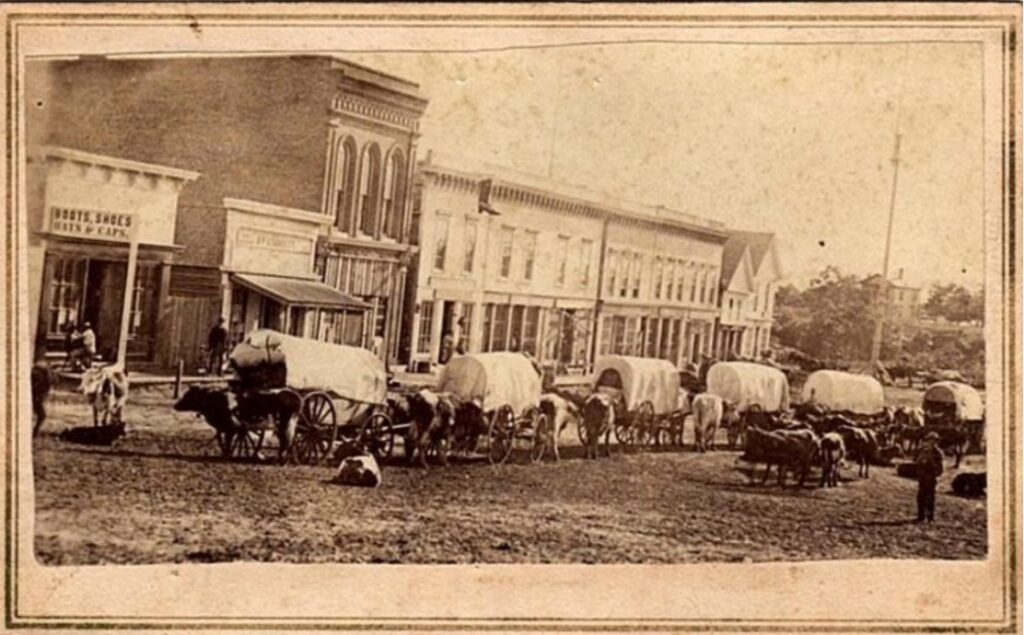
One other dramatic shift is captured by NY Tribune editor Horace Greeley who exclaims: “Go West young men and grow with the nation.” By 1840, 28% of the population live outside of the original east coast colonies.
They are also clamoring for what they see as “Manifest Destiny,” to move along the already explored Oregon and Santa Fe Trails past the Mississippi River and across Mexican land to California.
Southerners in the east regard this as imperative, as the path to opening new plantations and auctioning off their “excess slaves” at windfall profits.