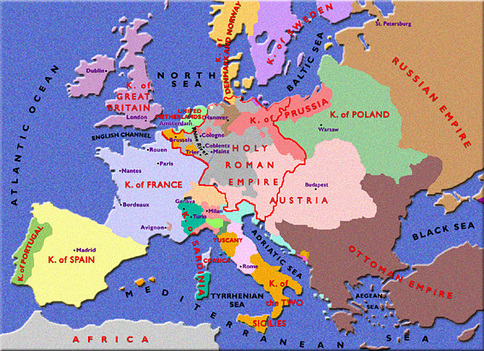
Section #1 - The Napoleonic Wars: 1803–1815
Epilogue
Following the turmoil of the French Revolution and the Napoleonic Wars, the monarchs of Europe are eager to restore their authority and permanence by creating a stable balance of power between their nations.
They use the 1814 Congress of Vienna and the 1815 Paris Peace Conference to attempt to achieve these ends.
At the center of the diplomacy lies ongoing fear of France and a wish to contain any further thoughts of expansion on her part.
Within France itself, a “constitutional monarchy” is created under the Bourbon King Louis XVIII, Napoleon and his heirs are banned for life, reparations of 700 million francs are demanded and foreign troops remain on French soil until 1818.
In addition, steps are taken to surround her with more formidable border states:
- To her southwest, along the Pyrenees, the Bourbon King Ferdinand VII is returned to the throne of Spain.
- Her southeastern border with Italy is controlled by the Kingdom of Sardinia/Piedmont backed by Austria which gains control of Milan and Tuscany.
- Directly east of central France lie a jumble of states sharing both French and German roots, including what will become Switzerland, Alsace-Lorraine and Luxemburg.
- But to her northeast lie two sizable forces – the first being the new United Netherlands, with its seven provinces, including the two Hollands, under King William I of Orange.
- And then Prussia, which has traded off some of its claims to Poland to acquire a toehold along both banks of the Rhine River, in the resource rich Ruhr Valley.
When the Prussian minister Bismarck finally patches together a united Germany in 1867, France will have found a powerful foe all along its eastern border.
What of Britain, Napoleon’s original nemesis from the time he came to power?
Their prize is absolute control of the seas with the Royal Navy and of their colonial empire stretching around the globe.
In the end, the French Revolution and the Napoleonic Wars have shaken the monarchical pillars of Europe from Lisbon to Moscow. But, by in large, the work done in 1815 at the Congress of Vienna and The Treaty of Paris restores their crowns and deliver relative stability over the next one hundred years.