Section #1 - The Napoleonic Wars: 1803–1815
Chapter 6: Napoleon’s Armies Sweep Across Europe
But he is characteristically undaunted by the loss at Trafalgar, and resumes his land war in Europe.
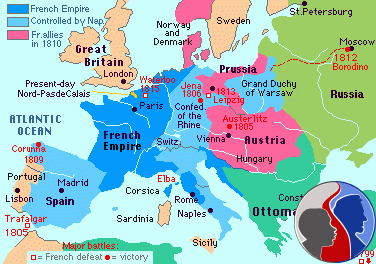
On December 2, 1805, in the nine hour “Battle of The Three Kings” – near Austerlitz (now in the Czech Republic) — his undermanned force (73,000 vs. 86,000) pulls a stunning victory against Alexander I of Russia and the Holy Roman Emperor Francis II. Casualties for the day total a staggering 36,000 men. In response to the loss, Francis gives up his Holy Roman title and becomes simply Francis I, King of Austria.
Less than a year later, on October 14, 1806, Napoleon soundly defeats the 110,000 man Prussian army, in the two-part battle of Jena-Auerstadt, winning control over territory in what is now central Germany and Poland. Casualties here are even greater than at Austerlitz, totaling 50,000 soldiers.
With these two pivotal triumphs, he now effectively controls all of Europe, except for Portugal, and he again moves against the British by imposing a Continental Blockade halting all trade with England in his Berlin Decree, issued on November 21, 1806.
Despite concessions from Portugal, Napoleon and his Spanish allies invade, capturing Lisbon on December 1, 1807, as the royal family transfers their regency to the colony of Brazil.
Further intrigue follows in February 1808, with Napoleon making a move he has long avoided, turning against Spain. The betrayal catches the Spanish army by surprise and it quickly gives way. However, bloody public uprisings occur in many cities, including Madrid, and lead on to the reprisal executions later immortalized by the artist, Goya. It is not until May 5, 1808, that Napoleon is able to name his older brother, Joseph, King of Spain.
While the local Spanish population refuses to bend to the French will, and guerilla “(“little war”) actions persist over time, supported in part by British expeditionary forces, Joseph is able to remain on the throne until the tide turns against the French in 1812-13.
To the East, the Austrian monarch, Francis II, loser at Austerlitz, decides to challenge Napoleon once again. He does so in 1809 at Wagram, 6 miles northeast of Vienna, in a fierce artillery dominated battle that covers July 5-6, involves 300,000 men, and counts 80,000 casualties – with the French once again emerging victorious.
By 1810, Napoleon’s power is at a zenith.
He has effectively isolated Britain from its “Third Coalition” partners” on the continent – Austria, Prussia and Russia – by thrashing their armies and signing peace accords with each.
The only things limiting France’s horizons are the presence and superiority of the British navy – and the small chance that Napoleon will eventually make a strategic blunder.
In 1812 he will do just that.