Section #1 - The Napoleonic Wars: 1803–1815
Chapter 5: A Loss at Trafalgar Stalls the Invasion of Britain
By the late summer of 1805, Napoleon has completed his plan to invade the British Isles, and has assembled a naval armada of French and Spanish ships to support the attack. But the invasion is delayed after Austria and Russia enter the war.
Still, Napoleon is displeased by the lack of aggression he sees in the commanding officer of his fleet, Admiral Pierre-Charles de Villeneuve, who learns that he is about to be relieved.
On October 20, 1805, before his replacement can arrive, Villeneuve departs the port of Cadiz on the southwest coast of Spain, intending to sail south past Cape Trafalgar and the Straits of Gibraltar, into the Mediterranean and the French port of Toulon.
Villeneuve’s fleet is formidable, comprising 33 heavy duty warships, with some 30,000 sailors and 2,568 guns.
At 11AM on October 21, they encounter the British navy, under the command of Captain Horatio Nelson, aboard his HMS Victory.
Nelson is already a legend within the Royal Navy. He enlists as an Ordinary Seaman at age twelve, serving under his uncle, who turns him into a first rate sailor, despite his lifelong bouts of seasickness. By December 1778, age twenty, he is Master and Commander of the sloop HMS Badger. He then becomes a national hero in February 1797, after capturing two Spanish warships at the Battle of St. Vincent.
He is almost killed on multiple occasions. In 1794 enemy shot leaves him blinded in his right eye. On July 24, 1797, his left arm is shattered by a musket ball and amputated. In 1798 he is knocked unconscious by shrapnel during the victorious Battle of the Nile, after which he is awarded the honorary titles of Baron and Viscount.
On October 21, 1805, Nelson has been battling the British and French off and on for some twelve years. He is 47 years old and Vice Admiral of the White (ensign) Fleet, second highest command in the Royal Navy. He has 27 warships at his disposal, with 17,000 men and 2,148 guns.
At 8AM the two fleets spot each other from a distance, the French still heading south toward Gibraltar, the English coming at them from the west. Villeneuve order his four-masters “to wear” (or jibe), reversing course to head back to Cadiz. But Nelson keeps coming onto him. The famous command — “England expects that every man will do his duty”—is flagged up.
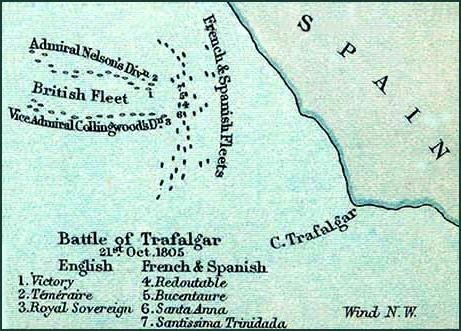
Around noon, the ships close on one another, with traditional naval strategy calling for Nelson to turn and “form lines of battle” stations parallel to the enemy. Instead, he plows straight ahead, striking the French in perpendicular fashion, and bringing on a “pell-mell” series of ship against ship action favorable to his more skilled seaman. This move, executed at no small risk of receiving initial broadside fire, also allows him to shoot into the sterns of many French ships, with the fire traveling through the entire length of the ship, to the bow.
Nelson himself commands the lead ship, HMS Victory, into the fray.
As Victory locks with the French Redoubtable, a musket ball takes Nelson in the left shoulder, slices through his seventh cervical vertebrae and lodges in his right shoulder. He knows immediately that the wound is fatal, and says so to his surgeon.
You can do nothing for me. I have but a short time to live. My back is shot through.
He lingers below decks for another 3½ hours, still issuing orders, before succumbing to his wound. His last words are recorded as “Thank God I have done my duty.”
And his victory at Trafalgar is striking. Villeneuve’s fleet has suffered one ship sunk, seventeen ships captured, another eleven partially damaged and only four escaping unscathed. Some 4,500 of their seamen are killed, with another 2,400 wounded and 7,000 taken prisoner. On the British side, no ships are lost for good and total dead and wounded total 1,450.
The Royal Navy has again demonstrated its supremacy on the high seas, and Napoleon casts aside all thoughts of an invasion of the English Isles.