Section #1 - The Napoleonic Wars: 1803–1815
Chapter 9: Napoleon Is Exiled Before Returning to Lose at Waterloo
The Treaty of Paris is signed on May 30, 1814. It restores France’s 1792 borders and exiles Napoleon to the Isle of Alba, only 10 miles west, off the Tuscan coast.
He spends 300 days on Alba before deciding to return to Paris, in response to rumors of popular uprisings against the monarchy, and fears that his country and army will be victimized at the on-going Congress of Vienna chaired by the Austrian minister von Metternich.
On March 1, 1815, he lands with 600 troops near the southern coastal town of Antibes and is back in Paris on March 19, with supporters flocking to his banner and with Louis XVIII in flight.
He quickly holds a plebiscite, showing the world that the French people back him.
He announces that his next step will be to restore France to its former preeminence in Europe.
In response a “Seventh Coalition” of opponents is formed. In addition to Austria, Russia and Prussia, it now includes Britain. Together they brand Napoleon an outlaw and reassemble a huge army to defeat him.
True to form when threatened, Napoleon goes on the offensive with his Armee du Nord, 130,000 strong and filled with veterans of his prior victories. As before, he intends to attack one nation at a time before the Coalition can concentrate the mass needed to overwhelm him.
He sets his sights on the heavily French oriented city of Brussels, 160 miles to the northeast of Paris, where he expects to encounter second tier British troops under Wellesley (soon to be Wellington) and worn out Prussians, under Blucher.
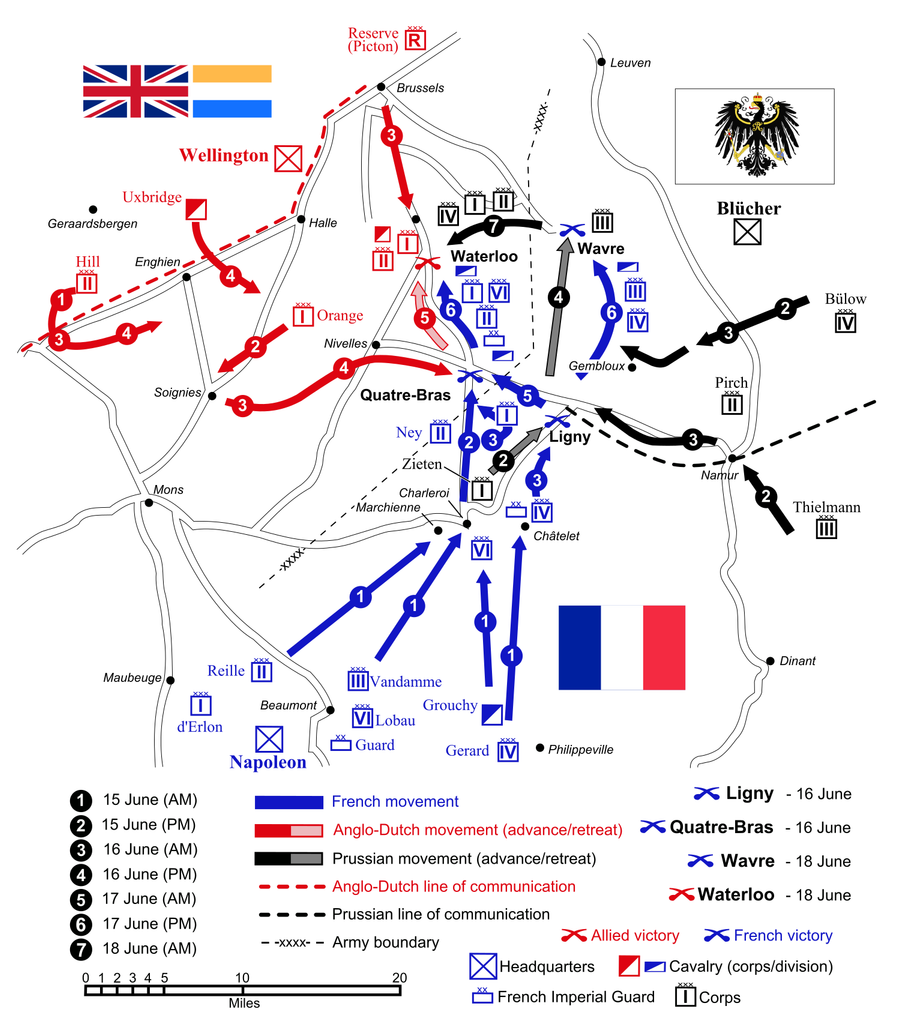
By Ipankonin – Own work (Original text: Self-made. Vectorized from raster image )Flags from, CC BY-SA 3.0, https://commons.wikimedia.org/wiki/Special:Redirect/page/3322777
As Napoleon draws near, the allies anticipate that he will sweep north in an attempt at encirclement, but instead he dives straight between them – crossing the River Sambre on June 15 and dividing his force in two. At Quatre Bras, on his left, he places 70,000 troops under General Ney to block the English, while he moves to his right, eastward, with 60,000 me to attack Blucher’s force of 83,000 around the town of Ligny.
Ligny will be Napoleon’s final victory.
The fight there opens at 2:30PM on June 16 and remains in the balance until Bonaparte sends in the Garde Imperiale around 7:45 and drives the Prussians off the field to the west. During the fight, the 72 year old Blucher leads a charge, but is knocked unconscious when his horse is shot and falls on him.
But Napoleon knows that the Prussians have only been bruised at Ligny, not routed, and he worries that they will try to reunite with the British.
He needs to attack again before that can occur.
When Wellington hears the outcome at Ligny, he retreats from Quatre Bras, north to a high ground position he has staked out on a 2.5 mile ridge running east and west in front of the town of Mont St. Jean. A country road runs along the ridge, and intersects on the east with the main route toward Brussels, some 8 miles north.
The British General is a long-standing proponent of defensive warfare, and he deploys his forces in a way that will enable him to grind down any frontal assault on his center.
He does this by fortifying three sets of farmhouses and out-buildings., on his right flank, the Chateau Hougoumont, a half mile down from the ridge; on his near left, La Haye Sainte, and on his far left, Papelotte, along the road west toward the Prussians. Each site is manned and ready to send enfilading fire into all French troops trying to ascend the ridge.
Wellington has one other trick up his sleeve, and that is the ability to have his troops along the ridge lie down along the back slope while enemy artillery charges fly over their heads.
At 2AM on the morning of June 18, the Duke, headquartered further north in Waterloo, hears that Blucher will provide one Prussian corps to support him, if the battle occurs later in the day. This convinces him to make his stand on his current ground.
As the dawn arrives, the two sides each assemble roughly 70,000 men to do battle in a confined space of roughly 2.5 miles by 2.5 miles.
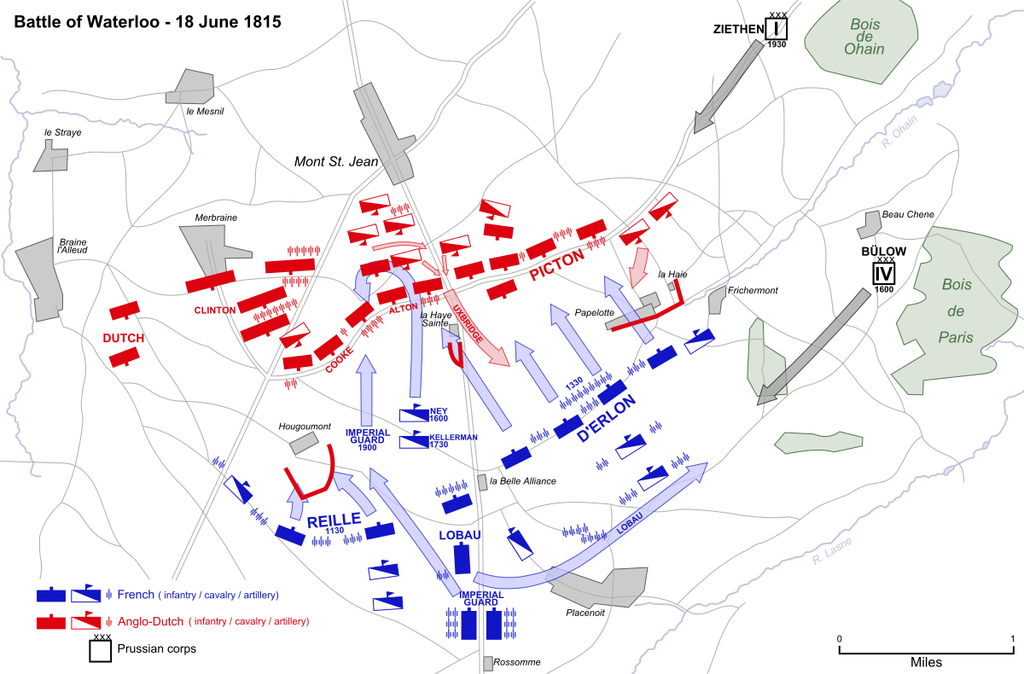
Battle of Waterloo
By Ipankonin – Vectorized from raster image, Public Domain, https://commons.wikimedia.org/wiki/Special:Redirect/page/3323133
Napoleon rises at 8AM, takes breakfast, and rides north to review his troop alignments – his light infantry chasseurs in bright green, the light cavalry hussars, mounted cavalry dragoons and carabineers with long guns strapped to saddles, cuirassiers wearing metal breastplates, the towering grenadiers, chosen to lead assaults, in their blue and scarlet uniforms and bearskin headgear designed to add to their natural height, the cavalry lancers with their 10 foot wooden staffs tipped by a sharp steel blade, and the artillerymen, “his most beautiful daughters,” whose mastery and courage have won him many a victory.
The French Emperor is eager to conquer the British in his front and march into Brussels for his evening meal. While he has never met Wellington before, he remains typically confident. And his troops cheer and call out his name as he passes in front of them.
Meanwhile on the ridge, the Duke’s troops are lined up shoulder to shoulder according to the traditional 21 inch spacing proclaimed in the military manuals of the day. Nobody cheers his presence when he passes, because he has forbidden all such shows from within the ranks.
Napoleon is in no rush to attack. It has rained all night on the 17th, and the field of rye across which the French will make their assault is muddy and slippery. So he waits until 11:30AM, at which time he makes his first move – against the crucial fortifications on his left at Hougoumont.
If Hougoumont falls, his cannoners can ascend the ridge on the left, send enfilading fire down the entire British line, and claim a certain victory.
Artillery fire announces the French move, and it is quickly returned in kind: 4-12 pound solid iron balls bouncing along the ground and gouging body parts, sometimes 15-20 soldiers at a time, before being spent. Next comes the infantry, marching in order up the slope to the Chateau. The hand to hand fight there lasts for 90 minutes, the only action on the field.
When Hougoumont holds out, Napoleon next tries the British right, a heavy artillery barrage followed by massed infantry, 24 columns deep, coming up east of the Brussels road and past the fortified buildings of La Haye Sainte. Again the defenders drive the French back, led by a heroic cavalry charge behind Sir Thomas Picton, who is mortally wounded.
It is now 3PM and a pause leads many to think the battle is over. While the Duke is constantly visible along the ridge, Napoleon remains slouched in a field chair 1.5 miles back from the action, sending few orders and trusting Marshall Ney to manage the tactics. Amazingly the two Frenchmen do not meet face to face from 9AM until 7PM.
Around 4:00PM, Ney, evidently on his own, decides to test the British center. He does so in highly irregular fashion, using cavalry alone, unsupported by infantry.
Wellington responds by “forming squares,” the traditional defense against cavalry. The goal here is first to discourage the horses via planted pikes, and then to shoot them – leaving their armor clad riders stumbling on the field.
And this strategy succeeds. Some 12,000 French cavalrymen ascend the slope in magnificent order, only to be broken up into mingling clusters by the square’s concentrated firepower. By some estimates they re-form on twelve occasions to charge again and be rebuffed.
By 4:30PM Wellington, stationed openly in one of the squares, tells an aides, “the battle is mine, and if the Prussians arrive soon, there will be an end to the war.”
But when the French finally take La Haye Sainte, his confidence lessens – and the outcomes again hangs in the balance. Wellington has now shot his bolt, his troops are fought out, and his hope for survival rests on the appearance of Blucher’s Prussians to plug his gaps.
This is Napoleon’s last best chance. He has held 14 regiments of his best troops, The Garde Imperiale, in reserve to the south. But when Ney requests them, Napoleon refuses to comply for the moment.
It is 7:00PM and the Emperor now knows that the Prussians, under Blucher and Bulow, are attacking his right flank, through Papelotte and, further south, at Plancenoit.
His options are running out. Does he use his reserves to hold off the Prussians or fling them up toward the British on the ridge? At 7:30PM he chooses the latter course.
He mounts his horse and leads five regiments of his Garde north to the battle.
The Gard, the “Immortals,” famed for their courage – “the Garde dies, it does not retreat.”
Many expect Napoleon himself to ride at the front of his troops, but he turns them over to Ney who has already had five horses shot from under him and is near exhaustion. Instead of taking the Brussels road up to the ridge, Ney veers left across the same ground as his prior cavalry charge. This adds 1,000 yards to the task, with the remains of the British artillery firing away.
As the Gard reaches the apparently accessible ridge, some 1,000 British infantrymen, the 1st Foot, under the command of Major General Peregrine Maitland, rise as if from nowhere, and shoot them down. And the Garde turns and flees back down the slope.
At this moment, the French have indeed lost the battle.
Wellington waves forward his troops, just as the Prussians break through from the east.
Napoleon rallies the remnants of the Garde Imperiale, south at La Belle Alliance along the Brussels road, and enables his troops to exit the field toward the south and west.
Around 9:30PM Wellington and Blucher meet up on the southern part of the field to seal their victory. The Duke has lost 15,000 killed and wounded; Blucher another 7,000.
Napoleon has lost 15,000 men – and his empire.
As the Coalition army closes again on Paris on June 24, Napoleon abdicates. He surrenders personally on July 22 to the British, seeking “hospitality and the full protection of their laws.”
According to the traditions of the age, Napoleon again suffers banishment not execution, this time to the Island of St. Helena, some 4,000 miles from France off the southwestern coast of Africa. He lives there until his death in 1821, presumably of stomach cancer. In 1840 his remains were shipped back to Paris, where he lies in Les Invalides.
Le jour de gloire has come and gone – for Napoleon and for revolutionary France.
le jour de gloire s’en est allé” — the day of glory has vanished