Section #1 - The Napoleonic Wars: 1803–1815
Chapter 8: The Loss at Leipzig Seals Napoleon’s Fate
Six weeks now pass before the largest ground battle prior to World War I is fought over a four day span, October 16-19, 1813, at the Saxon town of Leipzig, located 160 miles northwest of Prague.
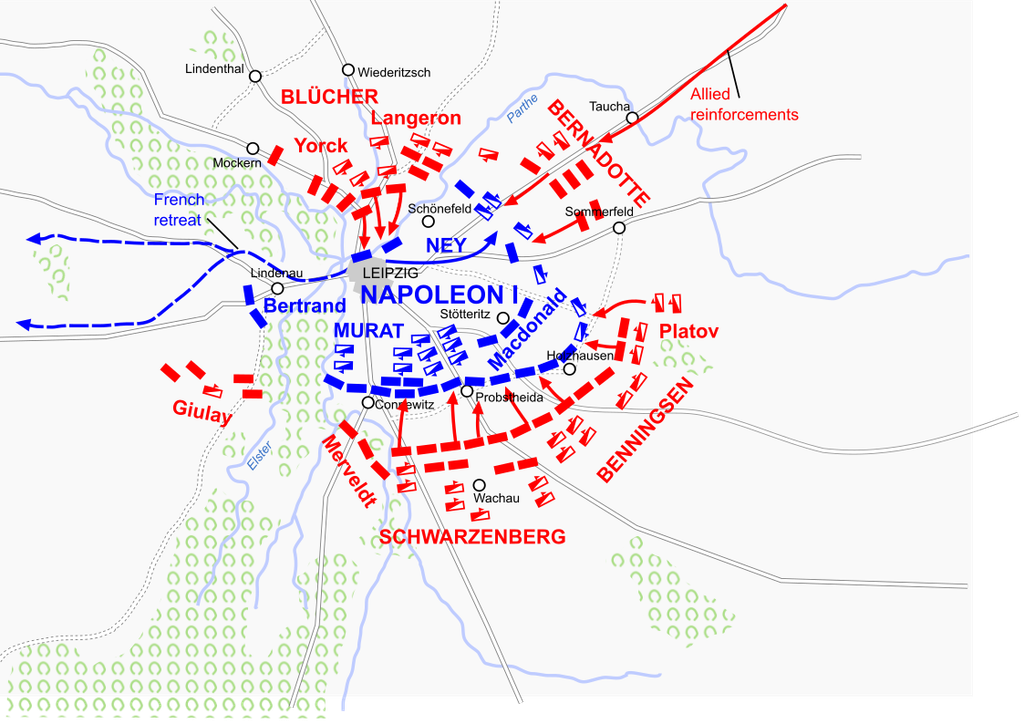
By ArdadN – Own workTransferred from en.wikipedia, Public Domain, https://commons.wikimedia.org/wiki/Special:Redirect/page/18212817
The Battle of Leipzig is by far the largest conflict of the Napoleonic Wars. The French are led by Napoleon and his most famous lieutenants: Michel Ney, Joachim Murat, Jacques MacDonald and Henri Bertrand. They concentrate their 198,000 men and 717 artillery pieces in the city itself and await the enemy, hoping they will arrive piecemeal to be beaten one nation at a time.
But instead comes a coordinated assault by the 370,000 troops and 1,384 cannon belonging to the “Sixth Coalition” comprising Austria, Prussia, Russia and Sweden, albeit not the British. Blucher commands the Prussians; Schwarzenberg the Austrians; de Tolly and Bennigsen the Russians; and Crown Prince Karl the Swedes. All three leading monarchs also arrive on site: Tsar Alexander I, Prussia’s Frederick Wilhelm III, and Austria’s Francis I.
The result is a four day slugfest from October 16-19, 1813, that seals Napoleon’s downfall.
The Grande Armee is much depleted from its losses in Russia, but holds its own on the first two days of battle. By October 19, however, it is facing heavy reinforcements by the enemy and is virtually surrounded inside Leipzig proper. Napoleon recognizes that the odds have turned against him and tries to negotiate a free passage out, but the initiative is refused.
That night he orders his troops to slip out of the trap by crossing the one remaining bridge over the Elster River to the west. After his lead brigades escape, however, they blow the bridge leaving many of their comrades behind. The butcher’s bill for the battle is staggering:
Casualties At The Battle Of Leipzig
| Soldiers | The French | Sixth Coalition |
|---|---|---|
| Killed / Wounded | 36,000 | 54,000 |
| Captured | 40,000 | N/A |
| Cannon Lost | 325 | N/A |
For perspective, the 90,000 total casualties at Leipzig tops the list of all 1-5 day battles in history, followed by the 68,000 lost on July 1, 1916 at the Somme and the 51,000 fallen on July 1-3, 1863 at Gettysburg.
Among the French dead are six generals, including the Polish warrior, Prince Jozef Poniatowski, who is wounded multiple times during the battle before drowning in the Elster River flight.This comes three days after Napoleon promotes him to Field Marshal of the Empire, the only non-Frenchman to ever attain the rank.
The defeat at Leipzig marks the first major loss for Napoleon not related to external factors such as outbreaks of disease or adverse weather conditions. Instead his battle strategy and execution are found wanting against a traditional enemy, this time with a large edge in manpower.
Upon hearing of his brother’s loss at Leipzig, Joseph Napoleon officially abdicates the throne of Spain on December 11, 1813. He will live on for another thirty years, first in America from 1817-32 (where he reportedly sells the crown jewels of Spain) and then back in Italy where he dies in 1868 and is buried in Paris at Les Invalides.
Napoleon is now in headlong retreat, back across the Rhine toward Paris, with the vastly superior coalition army on his tail.
He has one last moment of brilliance left, in the Five Days campaign, from February 10-14, 1814.
The allies have three massive armies coming after him, which means that his only chance lies in beating them in detail. His first move, pitting his 30,000 men against von Blucher’s 110,000 some 50 miles northwest of Paris leads to four consecutive victories.
But the allied wave coming his way is now overwhelming.
The coalition, however, is not all together on the endgame it seeks. Francis I of Austria and his foreign minister, Metternich, hope to conclude a treaty with Napoleon that would cost the French territorial gains, but leave the nation strong enough to avoid any chances of an English invasion of Europe.
But Alexander I of Russia in particular wants revenge, with Paris taken, Napoleon both deposed and humiliated, and the French army neutered. In the end, the coalition supports Alexander and marches on Paris. Their cause is helped by assurances to the war-weary population that the goal is to remove Napoleon, not harm the civilians.
After rear guard resistance is overcome, the allies occupy Paris on March 30, 1814 – the first time it has fallen in nearly 400 years.
On April 14, 1814, the French minister, Talleyrand, suggests that Louis XVIII, a Bourbon, be chosen to replace Napoleon and to rule under a charter restoring pre-Revolutionary conditions. All sides agree on this option.