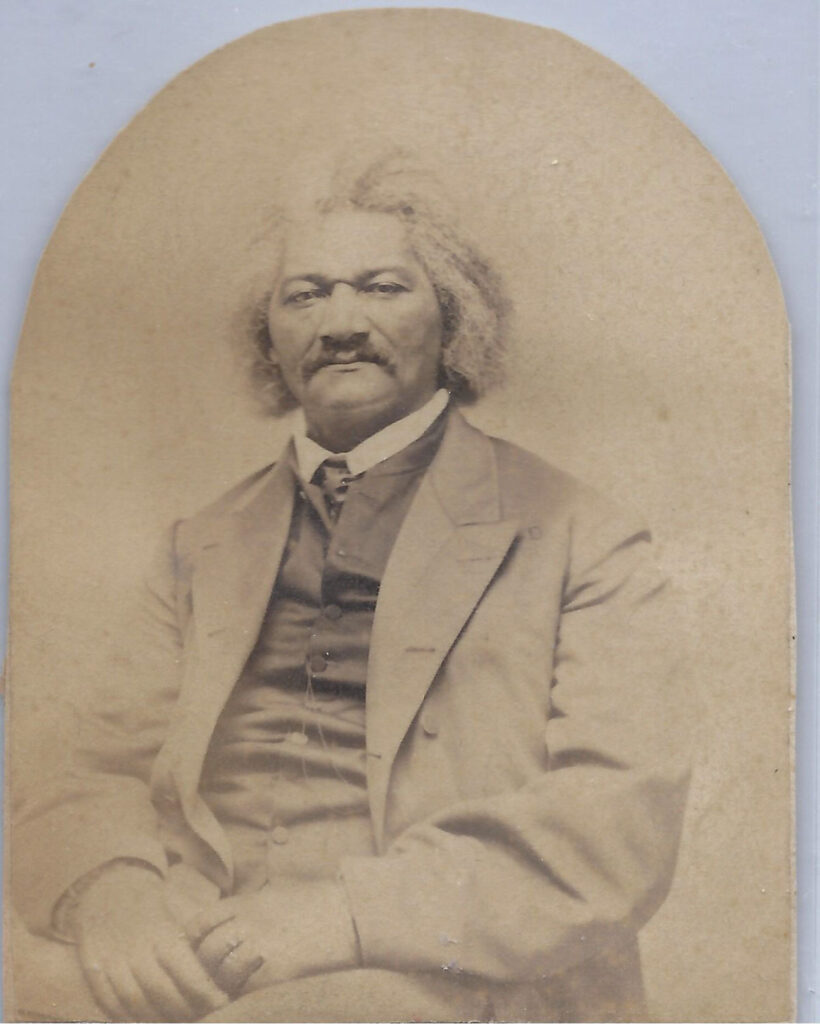
Section #1 - Lincoln’s Long Journey Home to Racial Equality
Chapter 24: Frederick Douglass Further Influences Lincoln’s Actions
Lincoln’s determination to achieve racial equality is further shaped by his interactions with Frederick Douglas, a Black man who, like Alexander Crummell, is without a doubt the match for any Whites that the President has encountered.
At first Douglass distrusts Abe for his early support of colonization; and then for his promise at the First Inaugural to protect slavery in the South. However, this changes in 1863 with the Emancipation Proclamation, which pre-dates their three face to face encounters in Washington.
The first of these occurs on August 10, 1863 when Douglass — who has led the efforts to recruit Black soldiers (including two of his sons) — is immediately ushered into the Oval Office and greeted by Lincoln who says: “It’s good to see you, Mr. Douglass, I’ve read about you and know you, how can I help?” And he does so by equalizing pay for the Blacks, improving their weapons and supplies, and supporting advances in their ranks.
The second meeting is initiated by Lincoln on August 19, 1864, where he asks Douglass for more military support to help ensure his re-election in 1864 over the Peace Democrats.
On February 21, 1865 Lincoln meets with Martin Delaney who works with Douglass to publish his North Star newspaper after being admitted (then denied) at Harvard Medical School. Despite the snub, Delaney studies on his own and, at the time of the visit, he is an Army Major, serving as surgeon in the 54th Massachusetts Regiment. He arrives seeking support for recruiting more black soldiers, and Abe responds in a note to Secretary of War, Stanton, urging his cooperation with “this very intelligent colored man.” In total roughly 179,000 African-Americans will enlist with the Union, some 10% of the entire force.
The third and final meeting between Lincoln and Douglass occurs on March 4, 1865, at the second Inaugural. Abe introduces him in the East Room as “my friend Fred Douglass” and has him seated next to him on the podium.
The bond is complete and Douglass calls the speech “a sacred effort.”